The Odisha Police has directed all District Superintendents of Police, Deputy Commissioners of Police in Bhubaneswar and Cuttack, and Special Reserve Police units in Cuttack and Rourkela to implement a comprehensive set of gender-sensitivity measures aimed at supporting women personnel.
Issued by the Crime Against Women & Children Wing on 25 November 2026 (Letter No. 8048/CAW & CW (W)), the circular recognises the disproportionate domestic load still borne by women officers alongside the round-the-clock demands of policing. It stresses that a supportive, gender-responsive workplace is essential both for the well-being of women personnel and for the overall efficiency of the force.
Key directions include:
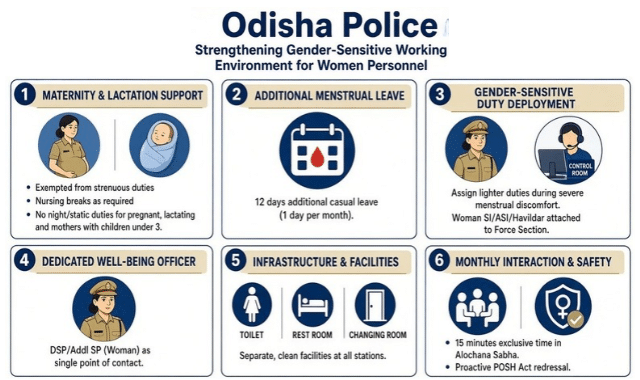
- Duty relaxations for pregnant and lactating officers: In line with the Maternity Benefit Act, 1961, pregnant and lactating women are to be exempted from strenuous duties, prolonged standing, law-and-order deployments, night duties, static guard duties, and assignments involving long travel or absence from headquarters. Nursing breaks and flexibility in timings must be provided. Women with children under three years of age are also to be spared night and static duties as far as practicable. District SPs have been asked to consider additional leave sympathetically for post-delivery recovery and childcare.
- Additional casual leave: The Finance Department’s order granting 12 days of additional casual leave annually (one day per month) for menstrual discomfort must be strictly implemented. The letter notes that some districts were denying this leave and directs immediate compliance.
- Menstrual and duty-deployment sensitivity: Officers experiencing severe menstrual discomfort should, wherever operationally possible, be assigned less physically demanding work such as control-room duties. To address the predominantly male supervisory structure in Reserve Offices, a woman Sub-Inspector, Assistant Sub-Inspector or Havildar is to be attached to the Force Section specifically to manage duty deployment of women constables and Havildars and to escalate genuine grievances.
- Dedicated well-being officer: Every District SP must designate a woman officer of DSP or Additional SP rank as the Well-being Officer for Women Police Personnel. She will serve as a single point of contact for women of all ranks and facilitate redressal of grievances.
- Infrastructure and sensitisation: Separate, clean toilets, rest rooms and changing rooms must be ensured at all police stations and duty locations. Previously constructed women’s rest rooms that have been diverted to other uses are to be restored. Supervisory officers are to receive regular sensitisation on gender-sensitive duty allocation and early identification of mental-health concerns, with emphasis on confidentiality and professional referral.
- Sexual harassment redressal and monthly interaction: Internal Committees under the Sexual Harassment of Women at Workplace Act, 2013, are to be directed to handle complaints proactively and promptly. During the monthly Alochana Sabha, District SPs must earmark at least 15 minutes exclusively for interaction with women police personnel, ensuring representation from every police station/post.
The circular ends with a clear mandate: District Superintendents and supervisory officers must personally monitor implementation and create a safe, supportive and gender-responsive working environment across Odisha Police.
The measures mark one of the more detailed institutional responses so far by a state police force to the dual professional and personal pressures faced by women in khaki.