
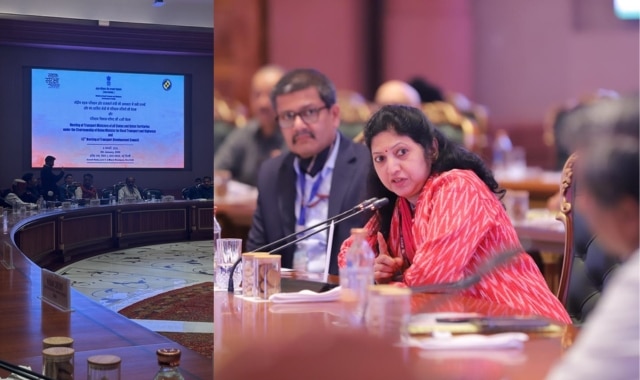
Odisha has solidified its position as a frontrunner among Indian states in road safety and transport governance, earning widespread appreciation at the Transport Development Council (TDC) Meeting held on January 7-8, 2026, at Bharat Mandapam, New Delhi.
The two-day meeting, organised by the Ministry of Road Transport and Highways (MoRTH) and chaired by the Union Minister for Road Transport and Highways, saw participation from Transport Ministers and senior officials of all states and Union Territories. Representing Odisha, Principal Secretary, Commerce & Transport Department, Usha Padhee, delivered a detailed presentation on the state’s achievements in road safety, digital governance, driver training, and technology-driven enforcement. She was accompanied by Transport Commissioner Amitav Thakur.
Odisha’s initiatives received particular praise from MoRTH. The state has achieved 100% readiness for the rollout of PM-RAHAT, the cashless treatment scheme for road accident victims offering coverage up to ₹1.5 lakh. Odisha also became the first state in India to complete two-way integration between e-DAR (electronic Detailed Accident Report) and CCTNS (Crime and Criminal Tracking Network & Systems), enabling seamless coordination among police, health, and transport departments. This integration, developed in collaboration with NIC, IIT Madras, and MoRTH, was highlighted as a national benchmark.
The Union Ministry lauded Odisha’s flagship community-based road safety programmes — SUVAHAK, AMA SUVAHAK, SUVAHAK SUVIDHA, Rakshak, and Junior Rakshak — noting that the proposed national Sadak Suraksha Mitra programme draws direct inspiration from these Odisha models.
In driver training infrastructure, Odisha has gone beyond central guidelines by establishing four state-of-the-art Institutes of Driving Training and Research (IDTRs), even though it qualifies for only two under the centrally sponsored scheme. MoRTH described these facilities as among the best in the country and indicated possible support for additional centres.
Recognising Odisha’s technical expertise and reform-oriented approach, MoRTH included the state in a high-level Committee of Secretaries tasked with framing pan-India transport rules and amendments, covering areas such as Automated Testing Stations (ATS), Vehicle Location Tracking Devices (VLTD), Pollution Under Control Certificate (PUCC), permit reforms, licence deduplication, and updates to the Motor Vehicles Act and Central Motor Vehicles Rules (CMVR).
The Ministry advised Odisha to further strengthen VLTD and High Security Registration Plates (HSRP) implementation and expressed concern over low PUCC coverage. The state has committed to intensified enforcement and awareness campaigns in response.
Odisha’s progress in faceless and contactless services was also commended, with 34 of 38 Aadhaar-linked services already operational. The state’s compliance under the Voluntary Vehicle Fleet Modernisation Programme (VVMP) was highlighted as exemplary.
Additionally, Odisha showcased its Integrated Road Safety Dashboard for district-level monitoring and the innovative Ghat Road Warning System, developed with IIT Bhubaneswar, which alerts drivers to blind curves on hilly roads.
The TDC meeting reaffirmed Odisha’s leadership in road safety, transport digitisation, and governance reforms, with several of its initiatives now shaping national policy and programme design.