Political friction over mineral policies has escalated sharply in Odisha, with opposition parties uniting to launch a fierce state-wide agitation against the newly enacted Mines and Minerals (Development and Regulation) Amendment Act, 2026 (MMDR Act-2026).
Senior leaders from the Indian National Congress, backed by the Biju Janata Dal (BJD), have accused the central and state governments of undermining Odisha’s constitutional rights and stripping the resource-rich state of vital economic dues.
Statewide Protests and Legislative Disruption
The legislative assembly has witnessed continuous disruptions, with opposition members wearing black scarves and raising slogans during the ongoing monsoon session.
-
Congress Agitation: Senior leader and MLA Tara Prasad Bahinipati officially announced that the party is ready to take to the streets to protect the state’s legitimate dues, terming it a “battle for the fundamental rights of Odisha.” Congress leaders have warned of sustained protests, including plans to blockade the residences of ruling party MPs.
-
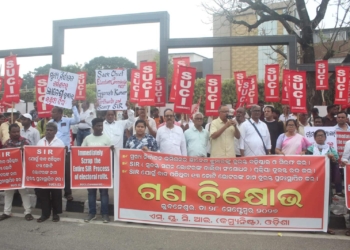
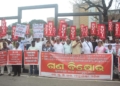
BJD Show of Strength: In a notable political alignment, the BJD has extended full support to the opposition front. BJD supremo Naveen Patnaik recently declared that his party would fight the legislation “until our last breath.” The party staged a massive protest rally at Lower PMG in Bhubaneswar, claiming that the state stands to lose between Rs 12,000 and Rs 20,000 crore annually, alongside nearly Rs 1 lakh crore in past arrears.
Constitutional Rights and Massive Financial Losses
The controversy stems from the newly introduced Section 9D under the MMDR Amendment Act, 2026, which the Centre brought in following the Supreme Court’s landmark nine-judge constitutional bench ruling on July 25, 2024. That ruling had empowered states to levy taxes on mineral rights and mineral-bearing lands.
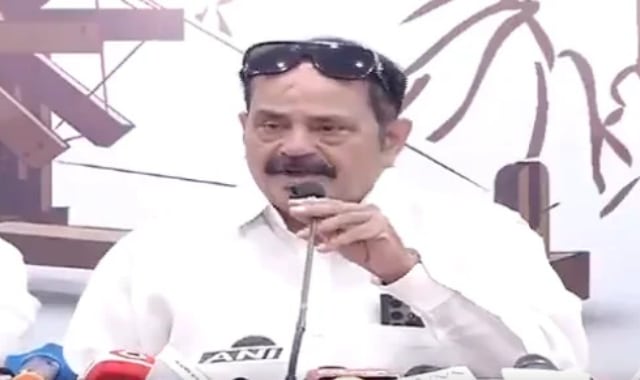
However, senior Congress leader and former Leader of the Opposition Narasingha Mishra, speaking at a press conference, argued that the 2026 amendment effectively blocks states from independently imposing taxes, cesses, or levies without central authorisation.
“Neither did the Centre give taxes, nor did the state ask,” Mishra stated, launching a scathing critique. He projected that the amendment will inflict a staggering Rs 17,000 crore financial loss on Odisha, heavily impacting past dues and prospective tax collections that rightfully belong to the state.
Echoing these concerns, Rajgangpur MLA C.S. Ekka lambasted the state government during a separate media briefing for remaining silent on the issue. Representing an indigenous-heavy constituency, Ekka warned that the central regulations and the new amendment weaken local governance frameworks like the PESA (Panchayats Extension to Scheduled Areas) Act, threatening tribal rights and reducing the authority of Gram Sabhas over local natural resources.
Government and Ruling Party Stance
In response to the mounting pressure, the ruling BJP has defended the legislation, maintaining that it will bring transparency to the mining sector, curb past irregularities, and safeguard states’ shares in royalties, District Mineral Foundations (DMF), and other revenues. Former Union Minister Dharmendra Pradhan previously asserted that roughly 90% of revenues from mining operations will ultimately flow back to the state.
Meanwhile, the Odisha government has stated that the exact financial impact of the 2026 amendment has not yet been precisely quantified, and formal assessments will be finalised once the comprehensive rules and regulations under the act are fully framed.
As opposition parties consolidate their frontline against the Centre’s mineral management policies, the political showdown in Odisha continues to intensify.