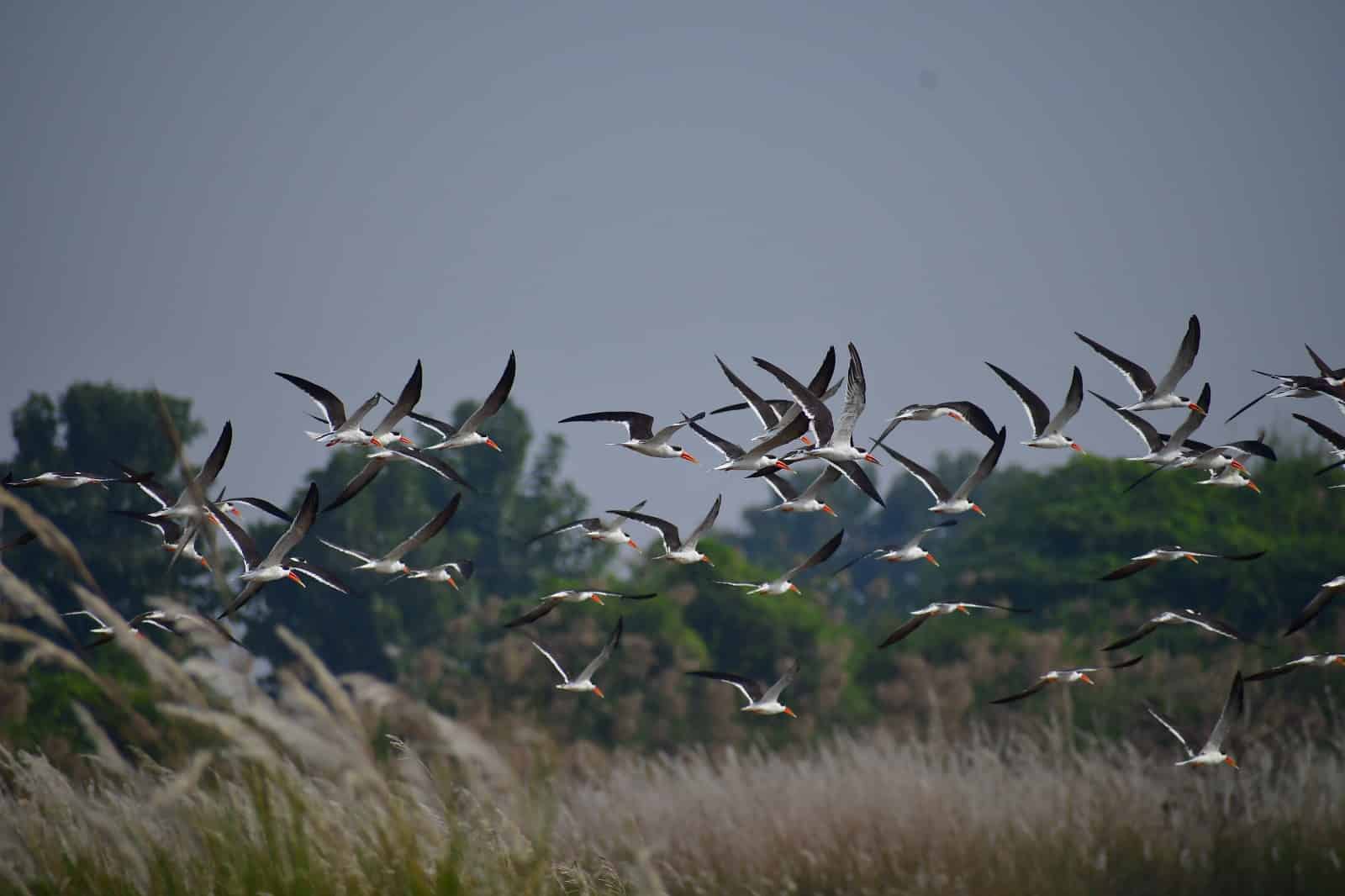
In a delightful development for birdwatchers and wildlife enthusiasts, three endangered Indian Skimmers (Rynchops albicollis) were sighted at the Manjeera Reservoir backwaters in Sangareddy district, Telangana. The sighting has brought renewed attention to the ecological importance of this wetland and its potential to support rare migratory birds.
Located around 60 kilometres from Hyderabad, Manjeera is an important wetland landscape comprising a reservoir, islands and surrounding habitats. The Manjeera Wildlife Sanctuary and its adjoining areas have recorded approximately 280 bird species, including several threatened and migratory birds.

The Indian Skimmer, also known as the Indian Scissors-bill, is one of India’s most distinctive river birds. Measuring approximately 40–43 cm, it has striking black upperparts, a white forehead, collar and underparts, and a short, forked tail. Its bright orange-red bill, tipped with yellow, is its most remarkable feature. The lower mandible is noticeably longer than the upper one, an adaptation that allows the bird to fly low over the water with its lower bill cutting through the surface to catch small fish. This unusual feeding technique is the reason behind its name.

Male and female Indian Skimmers look broadly similar, although males are generally slightly larger. Their diet mainly consists of small fish, crustaceans and aquatic insect larvae. They are often seen resting on exposed sandbars and river islands, sometimes gathering in groups along suitable water bodies.

Indian Skimmers breed mainly between February and May, nesting on open sandy islands and riverbanks. During the non-breeding season, they move towards suitable reservoirs, estuaries and coastal wetlands. Their movements are influenced by water levels, food availability and seasonal conditions. They are known from several Indian states, including Uttar Pradesh, Madhya Pradesh, Rajasthan, Gujarat, Odisha and Andhra Pradesh, with additional sightings in Telangana. Their movements are not limited to India; research has also confirmed movement between India and Bangladesh. There is no single fixed migration distance for this species.

The Indian Skimmer is classified as Endangered on the IUCN Red List. Habitat degradation, sand mining, dam construction, changing river flows, pollution, fishing activities and disturbance at nesting sites are among its major threats. Protecting exposed sandbars, clean water and undisturbed feeding grounds is essential for its survival.

Wildlife photographer and story writer Shiva Kumar, currently travelling across Indian states as part of his Wiki Commons of the Wild – Discover. Document. Celebrate India’s Natural Heritage mission, was excited to learn about the Indian Skimmer sighting at Manjeera. He immediately travelled to Hyderabad to document these remarkable wetland birds and capture their presence in Sangareddy district. His ongoing expedition aims to document around 1,000 species and contribute high-quality wildlife photographs to open-source platforms such as Wikimedia Commons, making nature’s records accessible to people around the world.

Kumar noted that Indian Skimmers had previously been recorded at other locations in Telangana, including Lower Manair Dam near Karimnagar. Their presence at Manjeera is an encouraging development for the region’s wetland biodiversity.
“Every wetland has its own ecological story. If we protect these habitats, maintain healthy water bodies and allow birds to feed and rest without disturbance, perhaps many lesser-known species will return to their suitable habitats during migration. Conservation is not only about protecting the species we already know; it is also about keeping our ecosystems healthy enough to welcome those we rarely see,” Shiva Kumar said.

While documenting the Indian Skimmers at Manjeera backwaters, wildlife photographer and story writer Shiva Kumar was delighted to encounter a pair of Pied Avocets as well. He believes these elegant migratory birds may have paused at the wetland during their seasonal journey to rest, feed and regain energy before continuing their migration.

The sighting of Indian Skimmers at Manjeera is more than a memorable birding moment. It is a reminder that healthy wetlands can provide refuge to threatened wildlife and that protecting these natural habitats is a shared responsibility.

Contributed by K. Shiva Kumar: Master’s in Journalism and Mass Communication | Conservation Storyteller | Wildlife Photographer