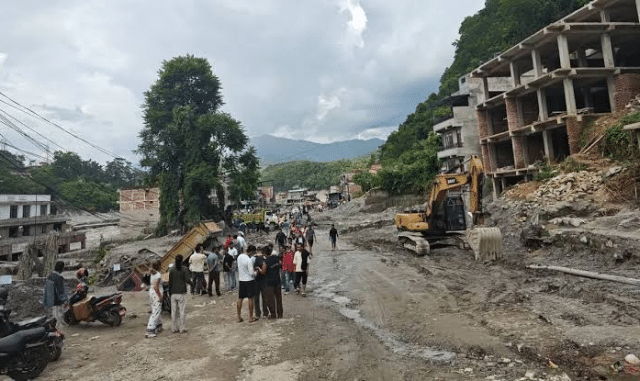
The devastating floods that struck Nepal in August 2026 caused an estimated US$1.66 billion in direct economic damage to physical assets, with infrastructure accounting for 83% (US$1.38 billion) of the total, according to a World Bank report.
The World Bank’s Global Rapid Post-Disaster Damage Estimation (GRADE) report aligns closely with Nepal’s preliminary government assessment, which pegged overall disaster losses—including broader economic impacts—at approximately US$2.7 billion. Tragically, official figures report 1,455 confirmed fatalities, while 5,285 individuals remain missing.
Physical damage was heavily concentrated in central Nepal, with Rasuwa district bearing 64% (US$1.07 billion) of direct losses, followed by Nuwakot and Dhading. The disaster severely crippled the energy sector, damaging 12 hydropower projects, transmission networks, and cutting off 430.7 MW of power—representing 10.6% of Nepal’s total installed power capacity.
Transport routes were similarly devastated, destroying 40 km of the crucial 82-km Rasuwa trade corridor connecting Kathmandu with China.
Emphasising the cascading risks in the Himalayan ecosystem, the World Bank advised Nepal to look beyond traditional “Build Back Better” frameworks. Rebuilding efforts, the bank urged, must focus on “building differently” by integrating risk-informed engineering, network redundancy, and improved early warning systems to withstand future climate disasters.