As India marked National Press Day under the theme “Safeguarding Press Credibility amidst Rising Misinformation,” prominent voices from the media landscape gathered at the National Media Centre to underscore the irreplaceable role of human judgment in journalism.
The event, graced by Union Minister Ashwini Vaishnaw, highlighted the urgent need to combat the “infodemic” fueled by artificial intelligence (AI) and digital disruptions, emphasising accuracy over speed and engagement.
In her opening remarks, Press Council of India (PCI) Chairperson Justice (Retd.) Ranjana Prakash Desai set a resolute tone, declaring, “AI can never replace the Human Mind—the Judgement, Conscience & Sense of Responsibility which guide a journalist.” She stressed PCI’s dual mandate: protecting press freedom while upholding ethical standards. Amid rising concerns over misinformation, Desai outlined PCI’s proactive measures, including fact-finding committees, welfare schemes to ensure journalists’ financial security, and internship programs to instil ethical practices in young reporters. “Journalism needs honesty, accuracy, and a commitment to share correct information,” she asserted, while cautioning against the misuse of AI tools. However advanced technology becomes, she added, it cannot supplant the human elements of conscience and verification.
The keynote address by Press Trust of India (PTI) CEO Vijay Joshi offered a roadmap to restore trust in the media. “Let accuracy take over the speed in traditional media and AI algorithm-led engagements in digital media,” Joshi urged, addressing the perils of paid news, advertorials, yellow journalism, and biased information bubbles. Drawing on the lessons of the COVID-19 pandemic regarding the rapid blurring of truth and falsehood, he warned that AI exacerbates these risks. Joshi celebrated PTI’s 77-year legacy of truth, accuracy, fairness, and independence—founded by 99 newspapers—and spotlighted initiatives like Fact Check for multi-layered verification. “Press freedom is not a licence to pollute the information ecosystem; journalism is a public service built on trust,” he reminded the audience, calling for training in ethics and critical thinking to equip future journalists.
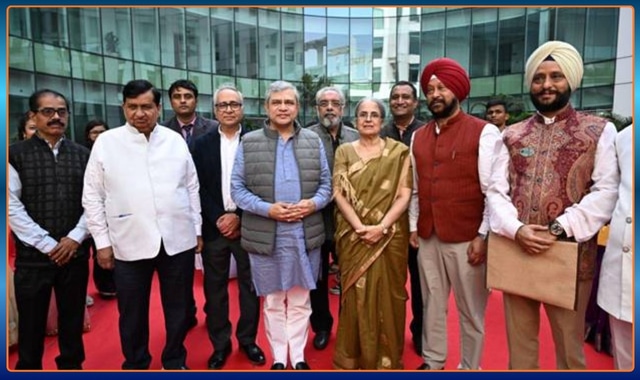
Union Minister for Information & Broadcasting, Railways, and Electronics & Information Technology, Shri Ashwini Vaishnaw, lent governmental weight to the discussions, reinforcing the press’s role as the “eyes and ears” of citizens in a democracy. Joining him were Union Minister of State for Information & Broadcasting and Parliamentary Affairs, Dr L. Murugan; Secretary, Ministry of Information & Broadcasting, Shri Sanjay Jaju; and PCI Secretary Ms Shubha Gupta. The event aligned with the Azadi Ka Amrit Mahotsav celebrations, organised by the Ministry of Information & Broadcasting.
Established in 1966 under an Act of Parliament (re-established in 1979), the PCI serves as a quasi-judicial body to foster self-regulation in print media, ensuring free and responsible reporting. It advises legislatures and authorities while elevating standards for newspapers and news agencies.
The gathering concluded with a live broadcast on PIB’s platforms, amplifying calls for collective responsibility in safeguarding press credibility. As misinformation proliferates in the AI age, India’s media stalwarts affirmed that empowering citizens demands unwavering commitment to verifiable truth.