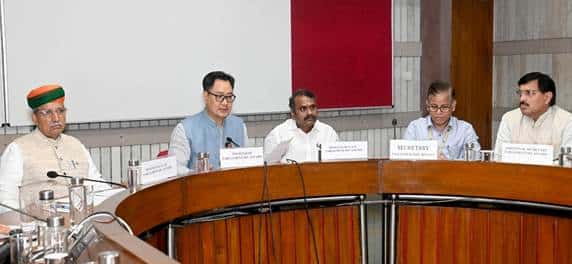
The Monsoon Session of Parliament, which began on 20 July 2026, concluded today after 19 sittings spread over 25 days. Both Houses of Parliament passed 12 bills, marking a significant legislative push despite relatively low productivity figures.
Lok Sabha recorded approximately 19% productivity, while Rajya Sabha managed around 39%. Eleven bills were introduced in the Lok Sabha and two in the Rajya Sabha. All 12 bills that cleared both Houses will now move toward implementation after receiving presidential assent where required.
Two key ordinances promulgated before the session—the Supreme Court (Number of Judges) Amendment Ordinance, 2026, and the Income-Tax (Amendment) Ordinance, 2026—were replaced by corresponding bills that sailed through both Houses.
Among the standout legislations is the Public Examinations (Prevention of Unfair Means) Amendment Bill, 2026. Introduced to tackle growing concerns over exam integrity, the bill strengthens the 2024 Parent Act. It mandates investigations within two months and trials within three months, empowers states and Union Territories to set up Special Fast Track Courts, allows Special Task Forces, enhances penalties, and provides a time-bound appellate mechanism. The bill has already received the President’s assent.
The Prevention of Insults to National Honour (Amendment) Bill, 2026 extends legal protection to Vande Mataram, the National Song. It makes it an offence to intentionally prevent the singing of the song or disturb any assembly engaged in its singing, bringing it under the ambit of the 1971 Act.
Other important bills that received the nod of both Houses include:
- The **Registration of Births and Deaths (Amendment) Bill, 2026**, which tightens rules for delayed registration and requires magisterial approval for registrations beyond one or two years.
- The **Micro, Small and Medium Enterprises Development (Amendment) Bill, 2026**, creating a national digital platform for voluntary MSME registration, improving access to finance, speeding up delayed payment dispute resolution, and replacing criminal penalties with graded fines and warnings.
- The **Bankers’ Books Evidence Bill, 2026**, modernising the definition of bankers’ books to include electronic, digital, cloud-based and virtual records for a future-ready legal framework.
- The **Kerala (Alteration of Name) Bill, 2026**, officially changing the state’s name from “Kerala” to “Keralam” in the Constitution’s First Schedule.
- The **National Co-operative Development Corporation (Amendment) Bill, 2026**, expanding the Corporation’s scope and removing outdated restrictions.
- The **Tribunals Reforms Bill, 2026**, aimed at ensuring independence, transparency and uniformity in tribunal functioning, and establishing a National Tribunals Commission.
- The **Mines and Minerals (Development and Regulation) Amendment Bill, 2026**, providing greater fiscal certainty to boost the mineral sector in line with Atmanirbhar Bharat and Viksit Bharat 2047 goals.
The Foreign Contribution (Regulation) Amendment Bill, 2026 was referred to a Joint Committee of both Houses for detailed examination.
Demands for Excess Grants for 2022-23 and the related Appropriation Bill were also cleared.
The session underscored the government’s focus on institutional reforms, ease of doing business, national symbols, and administrative efficiency. While the productivity numbers reflect the usual monsoon-session turbulence, the passage of a dozen bills signals tangible legislative output.
As the houses adjourned sine die, the legislative agenda now shifts to implementation and the next session.