A theoretical study from the Indian Institute of Technology Bhubaneswar has identified a specific surface of a common semiconductor as a promising host for persistent spin texture (PST), a quantum phenomenon that could help electrons keep their spin information far longer than usual. The work, led by Dr. Manish Kumar Mohanta of the Department of Physics, was published in *Physical Review B*.
Electrons carry both electric charge and an intrinsic angular momentum called spin. In spintronics, the goal is to use spin—alongside or instead of charge—to process and store information. In most materials, spins quickly lose their orientation through scattering. Persistent spin texture offers a way around this problem: the spins lock into a single preferred direction and resist randomisation. Materials that support PST are therefore attractive candidates for devices that need to preserve spin information over extended timescales.
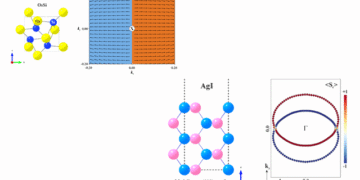
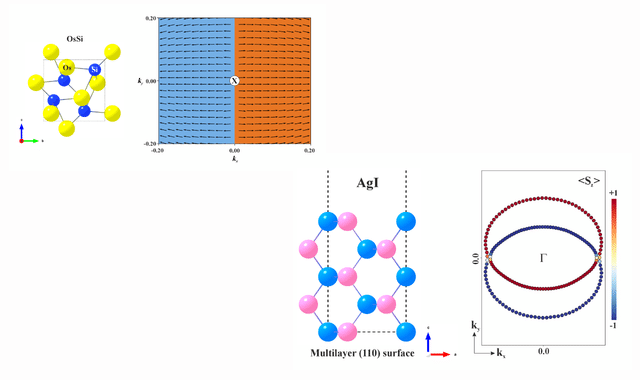
Using first-principles quantum-mechanical simulations combined with new mathematical models, Dr Mohanta showed that the (110) surface of cubic zinc-blende silver iodide (AgI) exhibits a clear unidirectional spin pattern. The texture remains robust under moderate mechanical strain, suggesting it could survive typical fabrication and operating conditions. At the same time, an electric field applied perpendicular to the surface can disrupt the pattern, providing a possible route to electrical control of the spins.
The same study also introduces mathematical models that explain an unusual partial persistent spin texture observed in the bulk semiconductor OsSi and raises a broader question: can a fully three-dimensional, nonmagnetic bulk crystal ever support a unidirectional spin pattern of the kind normally associated with lower-dimensional systems? While the primary experimental target identified here is the AgI surface, the theoretical framework developed for OsSi expands the set of materials and geometries in which researchers can look for long-lived spin textures.
For Dr Mohanta, the paper is also a personal milestone—his first independent research contribution since joining IIT Bhubaneswar as a Ramanujan Faculty. By combining atomistic simulations with tailored analytical models, the work supplies both a concrete material candidate and a clearer language for describing and predicting spin textures in nonmagnetic semiconductors.
If the predicted behaviour is confirmed experimentally, the (110) surface of AgI could serve as a platform for spintronic prototypes in which spin information is naturally protected and can still be switched by an electric field. More broadly, the study strengthens the theoretical foundation for designing materials that harness electron spin for energy-efficient computing and memory.
The research paper is available at: https://link.aps.org/doi/10.1103/6dcb-r2xb.