
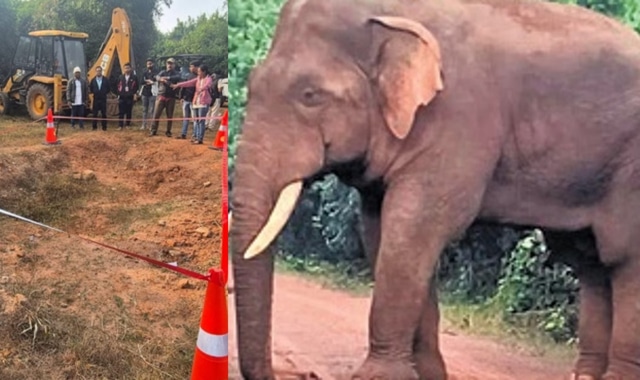
In a meticulous scientific operation, the Odisha Forest Department has successfully recovered the skeleton of Ramu, the iconic tusker of the Chandaka-Dampara Wildlife Sanctuary.
Over 200 bones were carefully exhumed from the Bharatpur forest area where the elephant was buried following his tragic death.
Led by renowned elephant expert Dr Shiba Prasad Parida, a 25-member team—including forensic specialist Dr Sudipta Ranjan Singh from AIIMS, Snake Helpline chief Subhendu Mallik, Bharatpur forest rangers, and other officials—conducted the 8-hour recovery starting from 9 AM on Saturday. The process began with extracting the skull, ribcage, and limbs, ensuring no damage to the remains.
The bones will now be transported to Godibari Prakriti Nivas near Bhubaneswar for preservation. The skeleton will undergo cleaning, chemical treatment, and expert reassembly. Unlike the skeleton of another famous elephant, Shankar, displayed at the Regional Museum of Natural History, Ramu’s remains will be kept at Godibari—his favourite habitat—for public education and wildlife awareness.
Ramu, the oldest and largest adult male elephant in the Chandaka-Dampara Sanctuary, was a beloved figure among locals and forest staff. He died on August 19, 2024, due to electrocution near the Bharatpur forest. Despite occasional crop-raiding incidents, Ramu was cherished and never harmed humans.
The recovery drew crowds of locals and officials eager to witness the process honouring the “gentle giant.” The Forest Department aims to keep Ramu’s memory alive, using his preserved skeleton to promote conservation and raise awareness about human-elephant conflicts.
Forest Minister Announces Research on Tusker Ramu
Odisha’s Forest and Environment Minister Ganesh Ram Singh Khuntia has announced that forestry students will soon undertake detailed research on Ramu, the legendary tusker of Chandaka Sanctuary.
Speaking to reporters, the Minister described Ramu as both legendary and iconic, noting that the elephant held a place of deep respect within the Forest Department. “Ramu was a senior member of the Chandaka forest family, and his life offers invaluable lessons for conservation,” Khuntia said.
The research will focus on how Ramu managed to survive for decades in a single habitat, a rare phenomenon in the wild. According to the Minister, understanding Ramu’s longevity and adaptation within Chandaka Sanctuary will provide insights into elephant behavior, habitat resilience, and human-elephant coexistence.
Ramu’s skeleton, recently recovered and preserved at Godibari Prakriti Nivas near Bhubaneswar, will serve as a central resource for this study. Khuntia emphasized that the preservation of Ramu’s remains is itself a landmark event, enabling future generations to learn from the tusker’s extraordinary life.
“Keeping Ramu’s skeleton at Godibari, his favorite habitat, is not just symbolic—it is a tribute to his legacy and a tool for education,” the Minister added.
The initiative is expected to inspire young researchers and strengthen Odisha’s commitment to wildlife conservation, while keeping alive the memory of the gentle giant who was cherished by locals and forest staff alike.