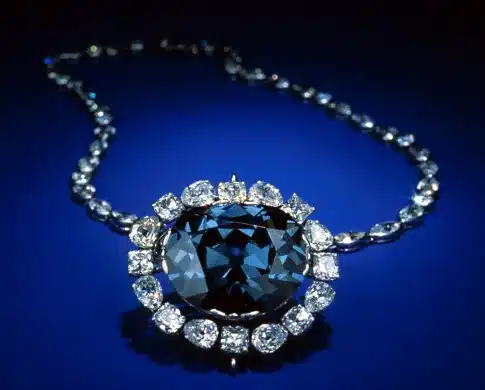
The Hope Diamond, a rare deep-blue gemstone weighing about 45.5 carats, is among the world’s most famous diamonds. Its striking colour and extraordinary history have also earned it a reputation as the “world’s most cursed diamond”.
But behind the dramatic stories lies a complicated history involving India, French royalty, theft, recutting and wealthy American owners. While the diamond’s connection to India is well documented, some of the darker stories surrounding its alleged curse are based on legend rather than independently verified historical evidence.
Today, the Hope Diamond is displayed at the Smithsonian National Museum of Natural History in Washington, DC.
Hope Diamond’s Indian origins
The recorded history of the gemstone begins in the 17th century. French traveller and gem merchant Jean-Baptiste Tavernier acquired a large blue diamond in India in 1666 and later sold it to King Louis XIV of France in 1668.
The diamond is commonly associated with the Kollur Mine in the Golconda region, although its precise origins remain uncertain.
One of the most famous legends claims that the original stone was stolen from an Indian temple, where it had been placed in the eye of a statue of the Hindu goddess Sita.
According to the story, the theft led to a curse being placed on anyone who possessed the gemstone.
However, there is no historical evidence confirming the temple-theft or curse story. The legend became an important part of the diamond’s later mythology and contributed to its reputation as an unlucky stone.
From the French Blue to the Hope Diamond
The original stone reportedly weighed more than 111 carats. It was recut after entering the French royal collection, producing a roughly 69-carat gemstone known as the French Blue.
The diamond became part of the French Crown Jewels and was associated with French monarchs before disappearing during the French Revolution in 1792.
Nearly two decades later, a blue diamond with characteristics matching the French Blue appeared in London. Researchers now generally connect this stone with the modern Hope Diamond, suggesting that the French Blue had been recut after its disappearance.
The gemstone received the name “Hope Diamond” after appearing in an 1839 catalogue associated with the Hope banking family, with the stone listed at approximately 45.5 carats.
How the ‘curse’ legend grew
The diamond’s reputation for bringing tragedy to its owners developed over generations.
Stories associated with the gemstone include financial ruin, deaths, murders and suicides involving people who supposedly owned or handled it.
Among those linked to the legend were members of the Hope family, European figures and later American heiress Evalyn Walsh McLean, who purchased the diamond from jeweller Pierre Cartier in 1911.
Cartier reportedly highlighted the diamond’s dramatic history when presenting it to McLean. The Smithsonian notes that some of the stories surrounding the stone were exaggerated or inaccurate.
McLean wore the diamond frequently, but tragedies in her family later became part of the curse narrative. Her son died young, her daughter died from a drug overdose and her marriage ended. She eventually faced severe financial difficulties.
However, linking these events directly to the diamond is a matter of legend rather than established causation.
Why the Hope Diamond remains famous
After McLean’s death in 1947, jeweller Harry Winston acquired her jewellery collection. In 1958, Winston donated the Hope Diamond to the Smithsonian.
The gemstone has since become one of the museum’s most recognisable attractions.
Its appeal lies not simply in the stories of a supposed curse, but in its remarkable physical characteristics and centuries-long journey across continents, royal collections and private ownership.
From its Indian connection and mysterious early history to the French Crown Jewels and its eventual home at the Smithsonian, the Hope Diamond remains a gemstone where documented history and enduring legend continue to overlap.