Tensions reached a boiling point across France on Saturday as an estimated 4,10,000 people took to the streets nationwide.
The mass demonstrations—fueled by widespread public anger over inadequate school funding and soaring living costs—degenerated into violent confrontations between security forces and protesters, placing mounting pressure on President Emmanuel Macron’s administration.
The high-stakes mobilisation came just a week after several French cities experienced severe unrest, riots, and looting. According to data released by the interior ministry, approximately 1,10,000 demonstrators converged in Paris alone, chanting anti-government slogans and holding union banners targeting President Macron and police policies.
Exceptional Violence and Mass Arrests
Interior Minister Laurent Nuñez announced that nearly 1,000 arrests were made during Saturday’s demonstrations. Nuñez attributed the severe friction to groups of black-clad individuals he identified as “ultra-left” extremists, noting that law enforcement officers faced an “exceptionally high level of violence”.
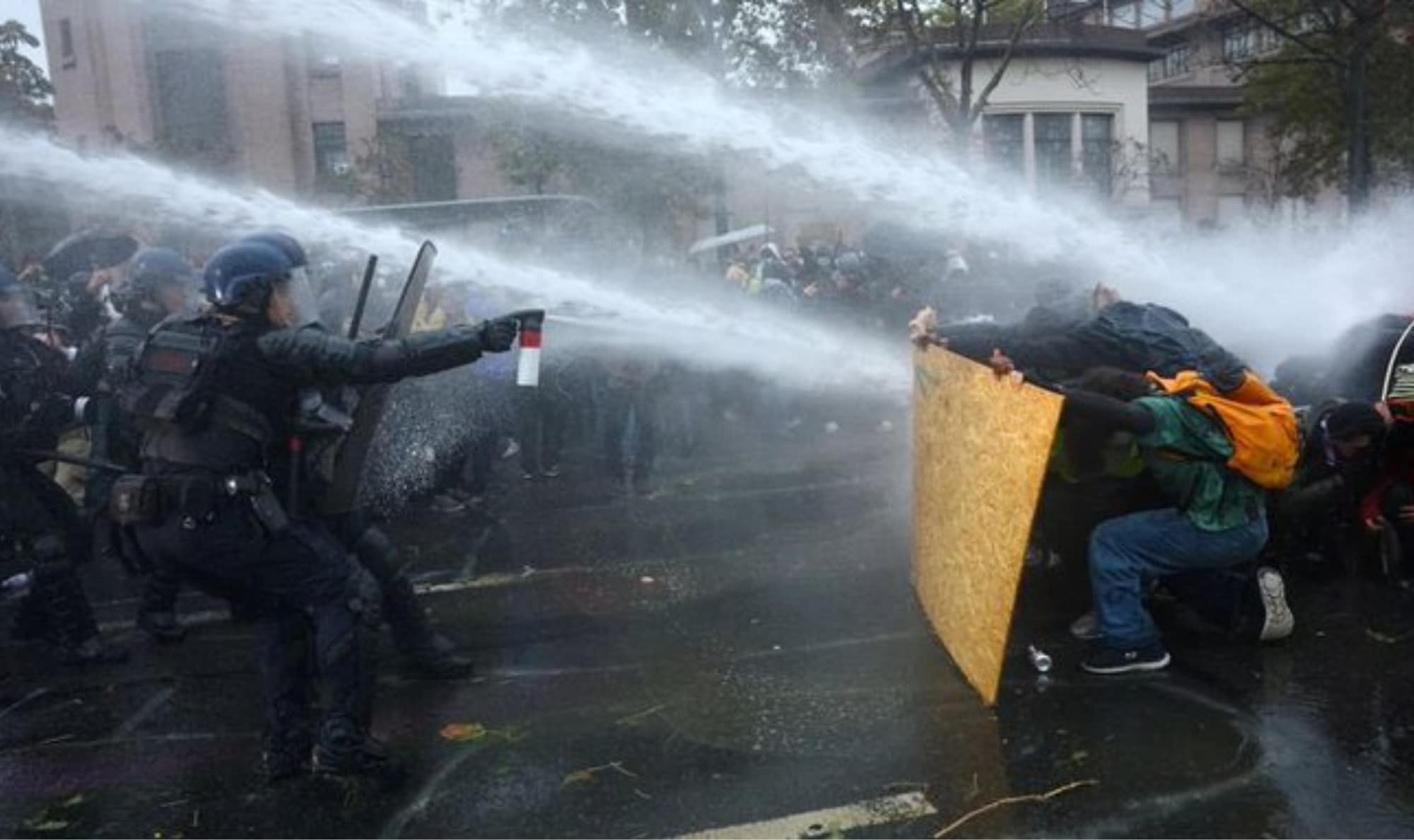
To contain the escalating volatility, French authorities mobilised a massive security apparatus consisting of 70,000 personnel nationwide. In Paris, riot police deployed tear gas and water cannons to disperse stubborn crowds of protesters who refused to clear key areas.
Despite pockets of intense chaos, Nuñez struck a measured tone in an evening press briefing. “The marches went off well,” Nuñez told reporters. “We should be thankful that freedom of expression was able to be exercised, but regret that a number of individuals were out to do only one thing: cause the marches to degenerate.”
Growing Political Strain for Macron
With the high-stakes French presidential election scheduled for May 2027, the persistent wave of civil unrest represents one of the gravest political threats of Macron’s tenure.
In an effort to preempt further destruction, the government instituted strict tactical measures, ordering police to keep protesters away from delicate city centres and commercial hubs packed with shops and businesses. Authorities also enforced limited curfews across selected urban districts in Paris and other major cities. Furthermore, Macron labelled non-union demonstrations “illegitimate,” directing security apparatuses to ban them outright.
Unions Vow Further Resistance
Student organisations and powerful labour unions have remained defiant, signalling that street mobilisations will persist until the government completely scraps its contested budget measures and injects immediate funding into decaying public services. As the political showdown deepens, the Macron administration faces a narrow window to restore public order and address deep-seated economic grievances before the country edges closer to the 2027 ballot box.