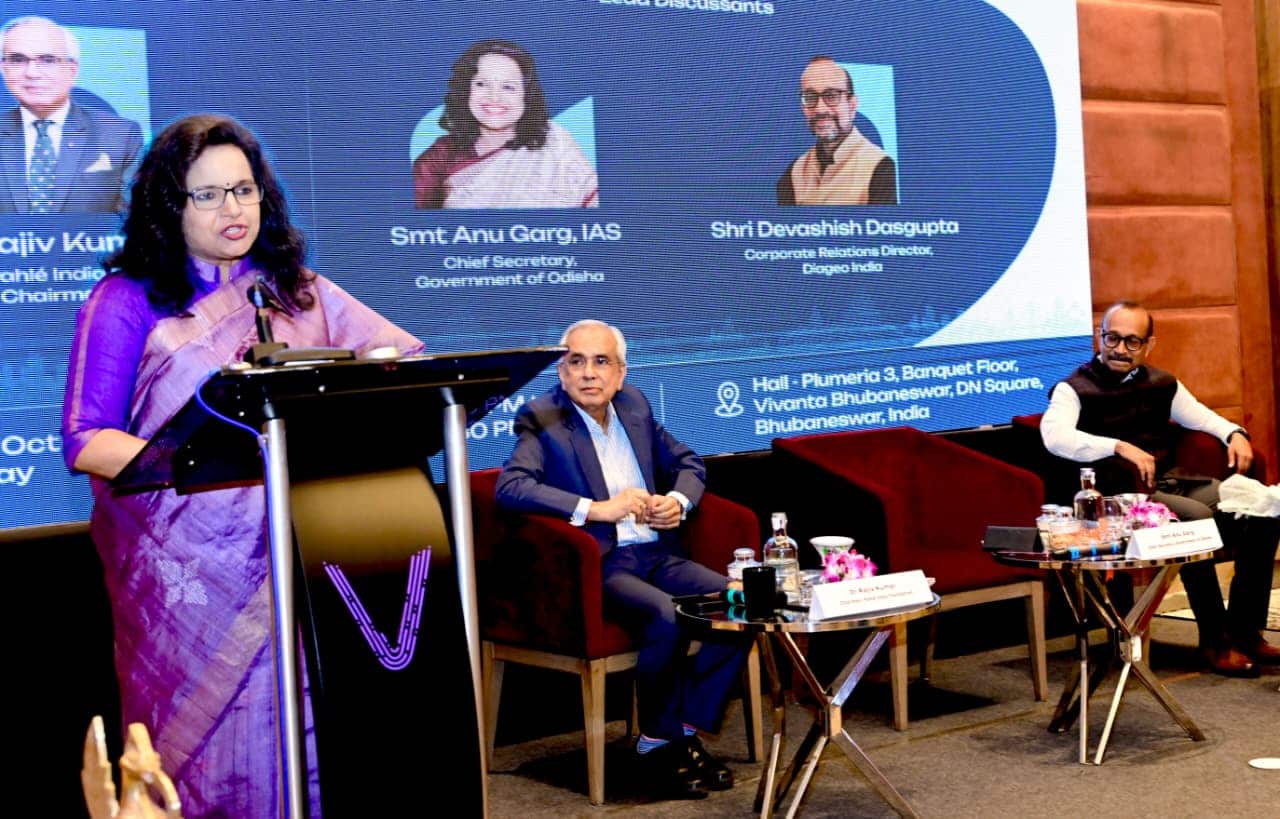
Pahlé India Foundation (PIF) hosted a discussion on“Viksit Odisha: Progress, Prospects and the Road to 2047” at Vivanta Bhubaneswar, DN Square, on Friday, 23 October 2026.
The event was graced by Odisha Chief Secretary, Anu Garg, IAS, as the Chief Guest, and brought together government officials, industry representatives and members of academia to discuss Odisha’s economic progress, investment opportunities and development priorities towards 2047.
Delivering the keynote address, Dr Rajiv Kumar, Chairman, Pahlé India Foundation and former Vice Chairman of NITI Aayog, outlined the structural changes needed to sustain Odisha’s economic growth. He stated, “Odisha produces 44% of India’s mineral value, but mining must be run as a high-value, high-capex industry. That means pairing minerals with ports and moving into green steel, green aluminium, green hydrogen and rare-earth magnets. Merchandise exports, now about $11 billion, need to reach $100 billion by 2036. Today eight districts generate 83% of merchandise exports, while the bottom 15 contribute barely 2%. To change this, he proposed a four-part formula for each lagging district: its One District One Product item, a global anchor buyer, a shared processing facility, and a road or rail link to a port. With its working-age window open until 2036, Odisha must skill its youth for the industries it is attracting.”
His presentation also highlighted how Odisha’s economy has grown tenfold in two decades. Dr Kumar stated, “Sustained nominal growth of 10% would make it developed economy by 2047, with a per capita income of about $18,000, well above the World Bank’s threshold for a developed, high-income economy. Getting there will need high-value mining, green metals and global anchor firms in selected districts. It will also need the bottom half of Odisha’s districts, which together contribute barely 2% of merchandise exports, brought into global value chains.”
Addressing the participants, Chief Secretary Anu Garg said Odisha has prepared a vision document outlining the ambitious goal of becoming a $500 billion economy by 2036 as part of the Viksit Odisha vision, and a $1.5 trillion economy by 2047, in alignment with the national vision of Viksit Bharat 2047. Outlining the state’s development strategy, she highlighted the EDGE framework-Economic Strength, Demography, Geography and Ecosystem-as a key pillar for realising the vision of Viksit Odisha.
Under Economic Strength, Chief Secretary stressed the importance of sustaining high economic growth by leveraging the state’s rich mineral resources, ensuring fiscal prudence, maintaining revenue strength, securing water resources and attracting greater capital inflows through investment. Highlighting Demography as a major advantage, she underscored the potential of Odisha’s educational institutions, including the World Skill Center, in developing a skilled workforce to meet emerging economic needs.
Referring to the state’s Geographical Advantage, the Chief Secretary highlighted the sustainable utilisation of iron ore and other mineral resources, along with the vast potential of the blue economy, deep-sea fishing and other marine-based economic activities. Under Ecosystem, she emphasised strengthening the ease of doing business and creating a conducive environment for investment and enterprise.
She further highlighted the State’s focus on emerging and high-growth sectors such as information technology, semiconductors, data centres, education and healthcare, while identifying tourism and agriculture as important drivers of future growth. She also stressed the need to harness Odisha’s coastal and marine resources to expand economic opportunities and generate employment.
Emphasising that development must go beyond economic growth, the Chief Secretary highlighted three key pillars-Prosperity, Wellness and Equity—to ensure improved quality of life, social well-being and inclusive development. Acknowledging the challenges ahead, she expressed confidence in Odisha’s aspirations and potential to achieve its development goals and contribute to the larger national vision of Viksit Bharat 2047 through the realisation of Viksit Odisha 2047.
The event also marked the launch of Pahlé India Foundation’s (PIF’s) report supported by Diageo India. The study highlights the importance of local supply chains, regulatory predictability and closer government-industry coordination in translating industrial activity into broader economic gains.
Titled Unshackling Odisha’s Alcobev Sector: Towards a Business-Driven Partnership Model, the report examines the sector’s economic contribution to Odisha, including revenue generation, employment, local procurement and environmental performance. The report identifies opportunities to strengthen local manufacturing and supplier networks, improve ease of doing business and enhance government–industry collaboration to attract investment, generate employment and promote sustainable growth.
Pathani Rout
PRO to Chief Secretary
***