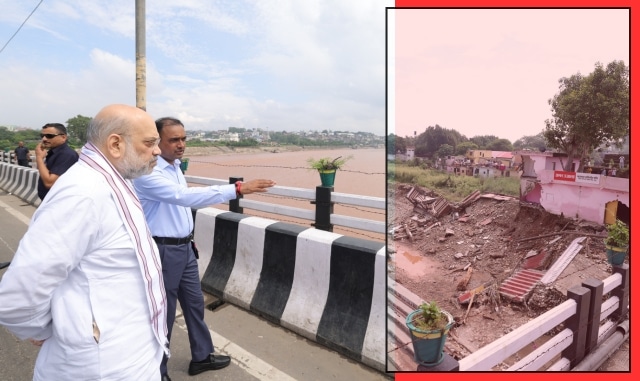
Union Home Minister and Minister of Cooperation, Amit Shah, visited the flood, rain, and landslide-affected areas of the Jammu division today to evaluate the damage caused by recent natural disasters.
Accompanied by senior officials, Shah met with affected residents in Chak Mangu village, inspected the damaged Tawi Bridge at Bikram Chowk, Shiv Mandir, and flood-ravaged homes, and chaired a high-level meeting to review the crisis response.
Expressing grief over the loss of lives, Shah emphasised that the Modi government has been actively supporting Jammu and Kashmir from the outset. He commended the coordinated efforts of the Jammu & Kashmir administration, National Disaster Response Force (NDRF), Army, and other agencies for minimising damage and saving lives. “Prime Minister Narendra Modi has personally monitored the situation, ensuring all resources are mobilised for rescue and relief,” Shah stated.
During the high-level meeting attended by Lieutenant Governor Manoj Sinha, Chief Minister Omar Abdullah, and senior officials, Shah stressed the need for a robust disaster response framework. He called for a critical review of the Glacial Lake Outburst Flood (GLOF) Early Warning System and urged the Meteorological Department and National Disaster Management Authority (NDMA) to leverage AI and data analytics to study cloudburst patterns and enhance early warning systems. “Improving our systems through critical analysis is the only way to move toward a zero-casualty approach,” he said.
Shah announced that survey teams from the Ministry of Home Affairs (MHA) will assess damages, with further assistance to follow. He directed the MHA and Union Territory government to prioritise damage assessment and ensure proactive health and water services, supported by medical units from the Army, Central Armed Police Forces, and Air Force. Additionally, Shah noted that Rs. 209 crore has been allocated to the State Disaster Response Fund (SDRF) to support relief efforts.
The Home Minister highlighted that timely warnings by the Central Government and Union Territory Disaster Management Authority (UTDMA) significantly reduced casualties. Over 5,000 people have been evacuated to safer locations, with 17 NDRF teams, 23 Army columns, helicopters, and other response units actively engaged. More than 80% of the electricity supply has been restored, clean drinking water is being provided, and health facilities are operational. Temporary restoration of critical infrastructure is underway, with road repairs and relief distribution in progress.
Shah assured affected communities that the Modi government stands firmly with them, providing immediate relief, financial aid, and technical support for rehabilitation and reconstruction. “The Government of India is committed to ensuring the safety and well-being of the people of Jammu and Kashmir,” he reiterated.