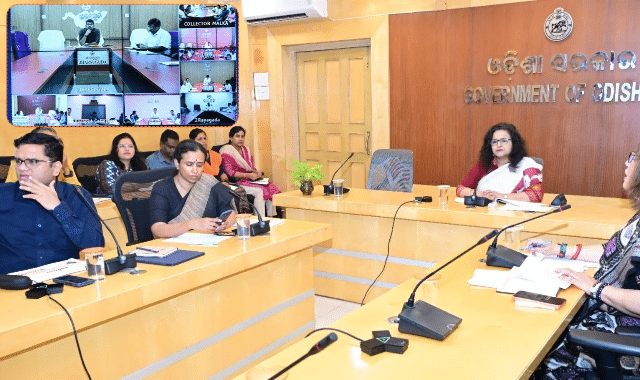
To accelerate progress in the state’s social sectors, Chief Secretary Anu Garg chaired the ‘PRAYAS’ review meeting today. The comprehensive session evaluated the ongoing programs, outcomes, and future strategies of the Health & Family Welfare, Women & Child Development, and School & Mass Education departments.
Senior officials and departmental secretaries attended the meeting to present data-driven analyses of their respective domains. District Collectors also joined virtually, sharing local progress reports and discussing successful grassroots models.
“Data to Action – Action to Results” Framework
Chief Secretary Garg strongly advocated for a governance model rooted in the “Data to Action – Action to Results” philosophy. She directed officials to optimize the use of technology to make public service delivery more efficient, targeted, and outcome-oriented. Key operational directives included:
- Routine District Monitoring: Establishing rigorous, regular evaluations of district-level progress.
- Increased Field Inspections: Mandating ground-level visits by administrative officers to ensure policy implementation.
- Replicating Success: Identifying successful initiatives in high-performing districts and adapting them across other regions.
- Departmental Synergy: Fostering seamless coordination between district administration and relevant departments to achieve breakthrough results in social welfare programs.
Healthcare: Dropping Mortality Rates and Better Referrals
The Health & Family Welfare Department reported significant improvements in maternal and infant care.
- Maternal & Infant Mortality: Continuous monitoring and enhanced prenatal care have led to a notable decline in both the Maternal Mortality Rate (MMR) and Infant Mortality Rate (IMR).
- Targeted Interventions: Early identification of high-risk pregnancies, streamlined referral systems, and specialized newborn healthcare have driven these improvements.
- Disease Control: The state has also recorded commendable progress in Tuberculosis (TB) control initiatives.
Nutrition: Leveraging the ‘Poshan Tracker’
The Women & Child Development Department presented an extensive analysis of the state’s nutritional landscape.
- Data-Backed Targeting: Utilizing a robust database, the department is actively identifying areas requiring immediate nutritional interventions.
- Poshan Tracker Integration: The digital tracker is actively evaluating the quality of nutrition services from individual Anganwadi centers up to the state level, successfully highlighting vulnerable pockets.
- Malnutrition Decline: The review highlighted a steep reduction in the number of children suffering from Severe Acute Malnutrition (SAM) and Moderate Acute Malnutrition (MAM).
Education: Advancing Foundational Literacy
The School & Mass Education Department highlighted concrete advancements in primary education, specifically focusing on Foundational Literacy and Numeracy (FLN).
- Core Improvements: Various districts have recorded improved literacy and numeracy rates, reflecting the success of recent primary education reforms.
- Resource Utilization: The effective deployment of Teaching-Learning Materials (TLM) by educators has significantly elevated the quality of classroom instruction.
- Chief Secretary Garg urged Collectors to conduct consistent reviews and field visits to ensure these educational programs remain highly effective.
Chief Secretary Garg emphasized that tangible, sustainable improvements in citizens’ living standards require an integrated approach. By viewing maternal and child health, nutrition, and early education as interconnected pillars, the state can vastly improve grassroots service delivery.
District Collectors, senior district officials, and Sub-Collectors have been strictly instructed to prioritize field visits to Anganwadi centers, schools, and hospitals to assess ground realities and implement immediate corrective measures.