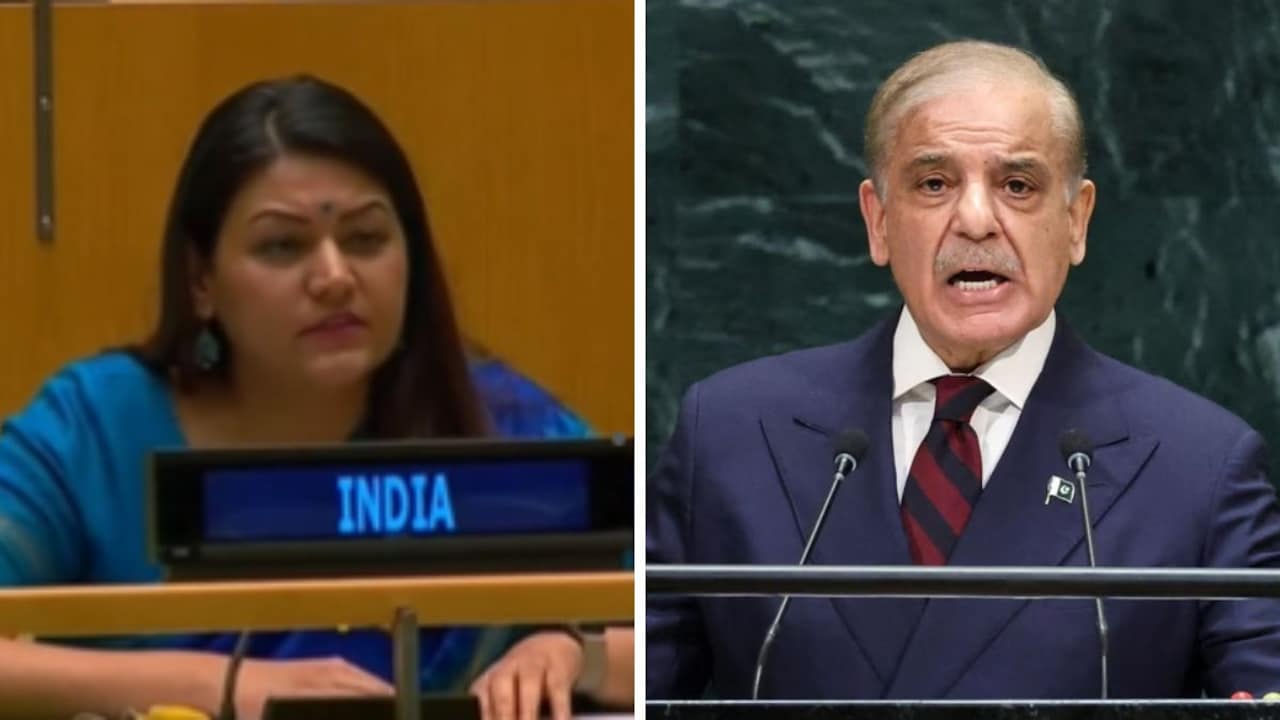
India on Saturday responded sharply to Pakistan Prime Minister Shehbaz Sharif’s address at the 81st United Nations General Assembly (UNGA), rejecting his remarks on Jammu and Kashmir and accusing Islamabad of pursuing a long-standing policy of cross-border terrorism.
Exercising India’s right of reply, Petal Gahlot, First Secretary at India’s Permanent Mission to the United Nations, said New Delhi had demonstrated its resolve to respond to terrorism and would continue to exercise its right to defend itself.
“At the heart of the issue is the long-standing practice of cross-border terrorism by Pakistan,” Gahlot said.
She added that India’s right to defend itself against terrorism “will be exercised and continued”, and said terrorism would have consequences.
India rejects Pakistan’s UN remarks
Gahlot accused Pakistan of presenting what she described as a misleading account of the situation while raising issues concerning India and Jammu and Kashmir at the UN.
“We are confident that this Assembly will recognise Pakistan and its policies for what they really are, not what its representative mendaciously projects it to be,” she said.
Gahlot also accused Islamabad of repeatedly raising allegations against India at international forums and said that repeating claims would not establish them as facts.
Pakistan has continued to raise the Kashmir issue at the UN, with Sharif calling for what he described as a “just and fair solution” and referring to a UN-backed plebiscite.
Diplomat questions Pakistan’s democratic claims
Gahlot also challenged Sharif’s references to democratic rights and human values, directing criticism at Pakistan’s political and military establishment.
She questioned Pakistan’s democratic credentials and referred to the country’s constitutional changes and the role of its military establishment.
These were statements made by the Indian representative during the right of reply and reflect New Delhi’s position in the ongoing India-Pakistan diplomatic dispute.
India raises terrorism record
Gahlot also invoked Osama bin Laden, referring to his presence in Abbottabad and questioning Pakistan’s criticism of India on terrorism.
She further accused Pakistan of hypocrisy over religious intolerance and minority rights, while citing what she described as the country’s record on blasphemy laws and treatment of minorities.
Pakistan has rejected India’s allegations concerning terrorism and has consistently disputed New Delhi’s characterisation of its policies and actions.
Kashmir remains a central point of dispute
Sharif had raised Jammu and Kashmir during his UNGA address, calling for a “just and fair solution” and referring to Pakistan’s longstanding position on the issue.
India reiterated its position that Jammu and Kashmir is an integral part of the country and rejected Pakistan’s claims.
The two countries continue to have sharply differing positions on Kashmir, terrorism and the status of the region.
Indus Waters Treaty also figures in dispute
Sharif also raised the Indus Waters Treaty in his UNGA address and warned that any attempt to stop, impede or divert Pakistan’s share of the Indus river waters would be treated as an “act of war”, according to his remarks reported by Hindustan Times. He also referred to the military confrontation between India and Pakistan in May 2025 and thanked US President Donald Trump for what he described as a “timely intervention”.
India and Pakistan have sharply divergent positions over the treaty and its status following the 2025 conflict.
The latest exchange at the UNGA comes amid continuing diplomatic tensions between the two neighbours, with terrorism, Jammu and Kashmir and water-sharing remaining among the key points of disagreement.