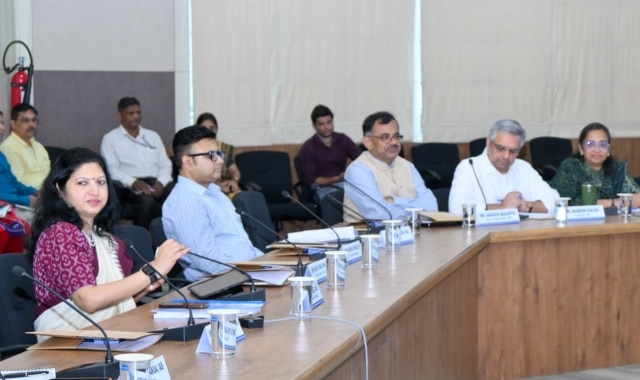
The Housing & Urban Development (H&UD) Department of the Government of Odisha, in collaboration with the Asian Development Bank (ADB), hosted an Inception Workshop on the “Preparation of Sustainable Urban Mobility Transition Plans for Odisha” at Kharavela Bhawan today.
The ambition behind the initiative is clear: establish a comprehensive mobility framework tailored for the Bhubaneswar–Kataka–Puri–Paradip Economic Region (BKPPER). Aligned with the ambitious roadmaps of Odisha Vision 2036 and Vision 2047, the project focuses on integrated regional transport planning, modernising public bus networks, and strengthening institutional governance.
A Vision for Access, Productivity, and Quality of Life
Setting a strong tone for the workshop, Smt. Usha Padhee, Additional Chief Secretary (ACS), H&UD Department, urged stakeholders to ensure the exercise yields an actionable, ground-level framework rather than remaining just a report on paper.
Drawing from her early administrative career in remote parts of the state, Smt. Padhee illustrated how inadequate mobility severely restricts people’s access to vital healthcare, education, and economic growth.
“Odisha is in a position where we can put the right systems in place as we move towards the next level of urbanisation,” Smt. Padhee said, stressing that early adoption of sustainable transit will help the state avoid the costly legacy traps faced by rapidly expanding urban hubs elsewhere.
Avoiding the Trap of Car-Centric Cities
Highlighting the global and regional necessity of public transit reform, Mr Kanzo Nakai, Director of the Transport Sector Office at ADB, shared insights from an ADB study across six major metropolitan areas. He noted that commuters in heavily congested cities lose up to four hours daily travelling—leading to staggering economic productivity losses.
Mr Nakai emphasised that because Odisha’s urban growth is entering a key phase, the state has a golden opportunity to leapfrog outdated, car-centric urban design in favour of seamlessly connected, low-emission public transport networks.
Collaborative Action Across Departments
The workshop witnessed active participation from key administrative leaders, including:
-
Amitav Thakur, Transport Commissioner
-
Arindam Dakua, Director, Municipal Administration (DMA)
-
Md. Siddique Alam, MD, Capital Region Urban Transport (CRUT)
-
D. Prasant Reddy, MD, IDCO
-
Chanchal Rana, Vice Chairman, Bhubaneswar Development Authority (BDA)
Senior officers from the Works Department, OSRTC, Odisha Police, KDA, along with District Collectors from Jagatsinghpur, Kataka, Puri, and Khordha, joined the deliberations alongside key representatives from ADB and lead consultant firm SYSTRA.
Key Focus Areas
The discussions centred around three key pillars presented by the ADB team’s Inception Report:
-
Comprehensive Regional Mobility Plan for BKPPER: Bridging the transit gaps across economic nodes.
-
Bus Service Transformation Roadmap: Enhancing fleet operations, reliability, and coverage.
-
Draft Odisha Transit-Oriented Development (TOD) Policy: Aligning land-use planning with high-capacity transit corridors.
The initiative marks a foundational step toward transforming BKPPER into a green, efficient, and inclusive economic engine for the entire state.