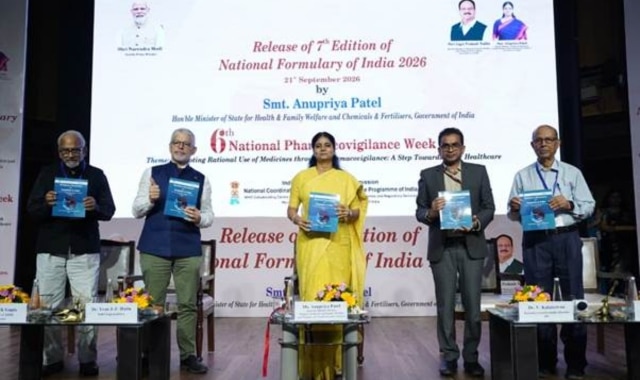
In a major step toward standardising healthcare safety and expanding post-market surveillance, Union Minister of State for Health and Family Welfare, Smt. Anupriya Patel, officially launched the 7th Edition of the National Formulary of India (NFI) 2026.
The unveiling took place at Dr Ambedkar International Centre during the 6th National Pharmacovigilance Week, organised by the Indian Pharmacopoeia Commission (IPC).
Alongside NFI 2026, Smt. Patel unveiled the Government-approved Biovigilance Programme of India and launched new digital tools, including the ADR-PvPI 2.0 Mobile App for iOS users and NFI Online.
A Milestone for Transplant Safety: Biovigilance Programme
The newly approved Biovigilance Programme of India represents a critical evolution in the country’s healthcare monitoring capabilities. Led by the Indian Pharmacopoeia Commission (IPC), the initiative establishes a framework to track, analyse, and prevent adverse events associated with biological products and procedures used in organ and tissue transplantation. The programme covers interventions for both donors and recipients, seamlessly complementing the existing Pharmacovigilance (PvPI) and Materiovigilance (MvPI) systems.
Global Stature and Expanding Reporting Networks
Highlighting India’s self-reliance (Atmanirbhar Bharat) in generating scientific safety evidence, Smt. Patel revealed that India has made dramatic strides on the world stage. The country has jumped from 123rd position (2009–2014) to 8th globally in overall contributions to the World Health Organisation (WHO) patient safety database.
To support this rapid data gathering, India currently operates 1,150 Adverse Drug Reaction (ADR) Reporting Centres across medical colleges, public health institutions, and private hospitals. The Ministry plans to decentralise this network further by extending adverse-event reporting capabilities down to primary healthcare centres nationwide.
What’s Inside NFI 2026?
The National Formulary of India 2026 acts as an authoritative guidance document to assist clinicians, pharmacists, and healthcare providers in prescribing rational, cost-effective, and evidence-based treatments.
-
Comprehensive Scope: Features 34 chapters, 20 appendices, and 653 drug monographs.
-
Special Formulations: Includes 42 fixed-dose combinations and 30 immunological products.
-
Policy Alignment: Updated to match the National List of Essential Medicines (NLEM) and running National Health Programmes.
-
Digital Integration: Accessible via NFI Online, offering direct links to immunisation schedules, Jan Aushadhi resources, and safe pharmaceutical disposal protocols.
Emerging Tech and Patient Participation
Addressing attendees, Smt. Patel emphasised incorporating emerging technologies—such as Artificial Intelligence (AI) and advanced data analytics—to detect safety signals early and streamline post-market drug surveillance. She called on patients to actively report adverse drug reactions using accessible channels like the new iOS application, digital web portals, and dedicated helplines to bridge the gap between clinical reporting and real-world consumer experiences.
The ceremony concluded with key remarks from senior health leaders, including Dr V. Kalaiselvan (Secretary-cum-Scientific Director, IPC) and Dr Yvan J.-F. Hutin (WHO Representative to India), reaffirming a unified commitment toward evolving India from the “pharmacy of the world” into a global benchmark for patient safety.