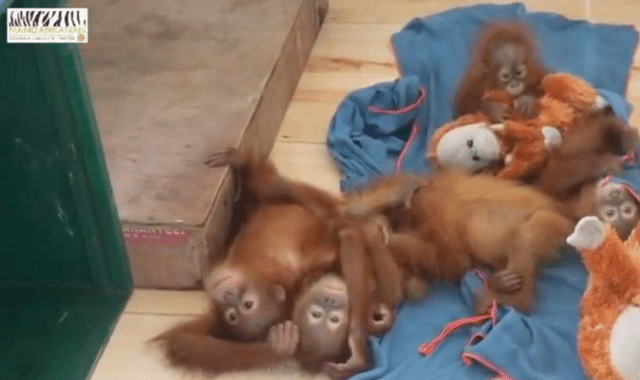
Five baby orangutans should never have been swinging in a casuarina forest in Odisha’s Baleshwar district. They are not Indian animals. They belong in the rainforests of Sumatra and Borneo. Their sudden appearance on September 8 has now become one of India’s most closely watched wildlife-crime cases — and the state government says the trail points overseas.
Forest, Environment and Climate Change Minister Ganesh Ram SinghKhuntia said on Friday that a foreign link is evident in how the infants reached Odisha. The Special Task Force has begun raids and inquiries in more than eight states. The Wildlife Crime Control Bureau is working with the STF. Teams have already travelled outside Odisha. Some people at the first layer of the operation have been identified. How far those links run — and who the mastermind is — will take longer.
“Catching the syndicate at the root will take time,” the minister said. “The investigation may stretch beyond a month. But STF has intensified the probe, and the guilty will be caught.” He added that the priority is not only this consignment. The government wants the network dismantled so Odisha is not used again as a dumping ground or transit corridor for exotic wildlife.
That caution is realistic. Orangutans are listed as Critically Endangered and sit on CITES Appendix I. In the illegal market they are treated as luxury pets, not living apes. Officials have earlier put their black market value at about ₹20–25 lakh each. Investigators have examined a black SUV seen near Bhograi the night before the rescue, CCTV from the Odisha–West Bengal border, and possible sea and Northeast land routes from Southeast Asia. A Digha hotel has also figured in the inquiry as a possible transit point. None of that yet equals a closed case.
The infants at Nandankanan
While detectives work backwards, veterinarians are working forward. All five orangutans are at Nandankanan Zoological Park and are described as stable. A technical committee is watching them daily.
Blood work has already told a harder story. One infant has severe anaemia. Two have mild anaemia. Reports on the remaining two are awaited. Iron supplements are being given along with fruit. X-rays of the chest, abdomen and skull have been taken. Blood, serum and nasopharyngeal swabs have been sent for laboratory tests — including checks for infection and for any abnormality in the lungs, heart or cranial cavity. Results, the minister said, are expected soon.
Indramani Nath, former project coordinator at the Centre for Wildlife Health, Odisha University of Agriculture and Technology, offered a blunt explanation for the blood deficiency. The five cubs never received their mothers’ milk. Traffickers put milk bottles in their hands. That is not how an infant orangutan is meant to grow. “They now need palatable, nutrient-rich food,” he said. His suggestion: grind papaya, pomegranate and apple into a soup. If needed, an antacid can be mixed into a liquid feed.
The image is grim and useful at once. These were not wild wanderers who drifted into Odisha. They were handled, bottle-fed, moved, and then left in a forest when a deal apparently collapsed. That is the signature of organised wildlife crime, not an accident of nature.
What comes next
DNA tests will help settle origin — and with it any future claim for repatriation to Indonesia or Malaysia. Until then, Nandankanan remains both a hospital and a holding facility. The minister said care will continue under the technical committee. Prevention, he stressed, is now as important as prosecution.
Five red-haired infants in a Balasore thicket exposed a pipeline that conservationists have warned about for years: rare apes smuggled from Southeast Asia to feed a growing exotic-pet market. Odisha has the animals. The harder job is finding the people who treated them as cargo. That, the minister made clear, will not be a one-week story.