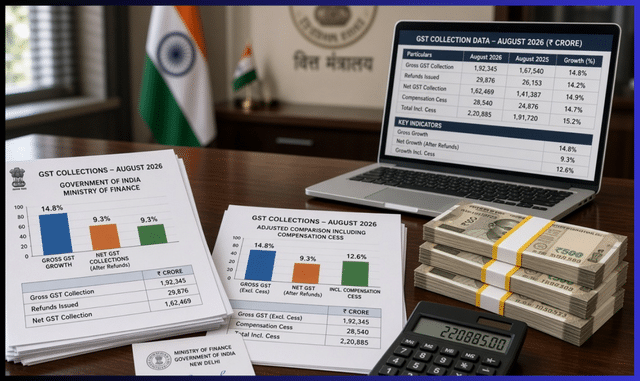
India’s GST collections for August 2026 looked like another strong month on paper. Gross revenue reached ₹1,99,853 crore, up 14.8% from a year earlier.
The government highlighted the figure as evidence of resilient consumption and formalisation. Then former Finance Secretary Subhash Chandra Garg posted a sharp rebuttal.
Garg argued the headline growth was inflated because the 2025-26 compensation cess had been “quietly excluded.” Add that levy back into last year’s base, he said, and five-month gross growth falls to 4.08% while net growth shrinks to 1.30% — “a pathetic performance.” He linked his post to an opinion piece questioning whether gross numbers were being used to paper over weaker net collections after a sharp rise in refunds.
Gross GST of Rs. 2 trillion led Govt to claim growth of 14.8% in August & 11% in 5 months. Govt played a trick though. 2025-26 GST Cess has been quietly excluded. When included, 5 month gross GST growth becomes 4.08% and net 1.30%, a pathetic performance. https://t.co/l8X4ygFXL5
— Subhash Chandra Garg (@Subhashgarg1960) September 9, 2026
The Central Board of Indirect Taxes and Customs (CBIC) responded the same day. It laid out a simple timeline. The GST Council decided to discontinue compensation cess on most goods from 22 September 2025. The remaining levy on tobacco and related products ended on 1 February 2026. After those dates there was, by law, no cess to collect. From November 2025 onward, official monthly releases showed any residual cess separately and calculated year-on-year growth only on the comparable CGST + SGST + IGST base, with a footnote.
1.The GST Council took a decision to discontinue the compensation cess effective from September 22, 2025 on all items except tobacco and related products. The cess levy on tobacco and related products was also removed from February 1, 2026. Accordingly, from the above period,… https://t.co/Ojo532dijH
— CBIC (@cbic_india) September 9, 2026
“A growth rate is meaningful only when it is computed on a comparable basis,” CBIC wrote. “Otherwise it is like comparing apples and oranges.” Retaining a levy that no longer exists in the current-year numbers measures something other than the movement of the actual tax base, the board said. Cherry-picking across two different datasets is “thoroughly misleading.”
The underlying numbers themselves are not in dispute. Gross domestic GST rose 9.3% to ₹1.37 lakh crore while import-related GST jumped 29% to ₹62,604 crore. After refunds of ₹31,795 crore — up 68% — net collections stood at ₹1.68 lakh crore, an 8.3% rise. For April–August, official gross collections are up 11% at ₹10.43 lakh crore.
What changed is the tax architecture. GST 2.0, rolled out from September 2025, merged most compensation cess into revised rate slabs and later replaced the tobacco cess with a new health and national-security cess plus higher excise. Officials argue that once a levy is legally extinguished, keeping it in the prior-year denominator no longer tracks the same tax. Critics counter that citizens and markets still need to know whether the overall tax take from the same economic activity is rising or stalling.
Both sides agree on one point: refunds have become a larger slice of the picture. Faster processing of inverted-duty and export refunds is policy, not accident. That makes net collections the more relevant measure of money actually reaching government coffers, even if gross collections remain the politically convenient headline.
The episode is less about a single month’s data and more about how India now reports a tax system that has been redesigned twice in twelve months. Comparable-base reporting is standard statistical practice. Whether that practice produces an overly flattering or a more honest picture of GST buoyancy after rate cuts and cess abolition is the real argument that will continue into the festive season.