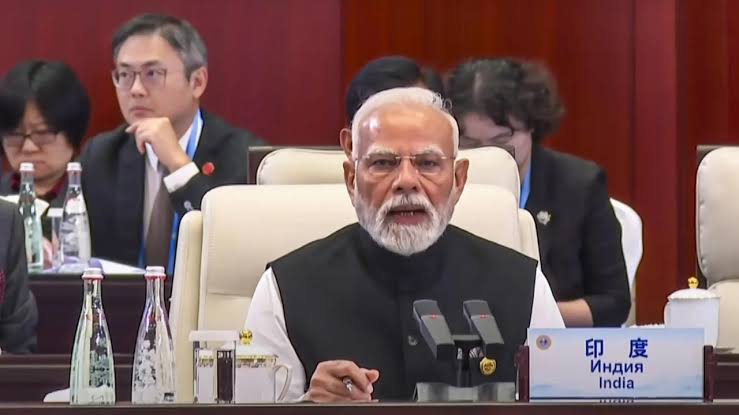
Prime Minister Narendra Modi on Tuesday called for dialogue and diplomacy to resolve wars and conflicts, saying there is “no solution on the battlefield” as he addressed the Shanghai Cooperation Organisation (SCO) summit in Bishkek, Kyrgyzstan.
Speaking at the summit in the presence of Chinese President Xi Jinping, Russian President Vladimir Putin and Pakistan Prime Minister Shehbaz Sharif, Modi also called for a united international response to terrorism.
“We must speak with one voice that there can be no place for double standards on terrorism,” Modi said, urging SCO members to dismantle the entire ecosystem that supports terrorism, including its financing, recruitment, radicalisation and safe havens.
PM Modi calls for dialogue over war
The prime minister’s remarks came as the SCO summit takes place amid conflicts in West Asia and the ongoing war in Ukraine, both of which have implications for global energy supplies, trade and economic stability.
“There is no solution on the battlefield,” Modi said, stressing that conflicts should be addressed through dialogue and diplomacy.
His comments reflected India’s longstanding position that differences between countries should be resolved peacefully while respecting sovereignty and territorial integrity.
Strong message on terrorism
Terrorism was a key part of Modi’s address, with the prime minister calling for collective action against terror networks.
He said the international community must reject selective approaches to terrorism and work together against the networks that facilitate attacks.
Modi’s remarks were particularly significant because Shehbaz Sharif was present in the same hall. India has repeatedly accused Pakistan-based groups of carrying out or supporting attacks against India, allegations Islamabad has denied.
The issue has remained central to India-Pakistan tensions, particularly following the Pahalgam terror attack and India’s subsequent military response under Operation Sindoor.
Modi stresses sovereignty in infrastructure projects
Modi also said countries should cooperate on infrastructure and connectivity projects, but such initiatives must respect the sovereignty and territorial integrity of other nations.
The remarks assume significance in the context of the China-Pakistan Economic Corridor (CPEC), a major infrastructure initiative connecting China’s Xinjiang region with Pakistan’s Gwadar port.
India has consistently opposed projects passing through territory it considers to be under illegal Pakistani occupation.
Why the SCO summit matters
The SCO brings together major powers and regional countries, including India, China, Russia, Pakistan and Iran. India and Pakistan became full members of the organisation in 2017, while Iran joined in 2023 and Belarus became a member in 2024.
The grouping was established in 2001 by China, Russia, Kazakhstan, Kyrgyzstan, Tajikistan and Uzbekistan. Its stated objectives include strengthening mutual trust, promoting good-neighbourly relations and expanding cooperation among member states.
This year’s summit is being held in an expanded “SCO-Plus” format, bringing together leaders from several partner and observer countries.
Modi’s message at a crucial moment
Modi’s address sought to place India’s positions on terrorism, sovereignty and peaceful conflict resolution at the centre of a major regional diplomatic gathering.
With leaders of China, Russia and Pakistan attending the summit, his call for a united approach to terrorism and his emphasis on dialogue underline India’s attempt to use the SCO platform to press its security and diplomatic priorities.
The summit comes at a time of heightened geopolitical uncertainty, making Modi’s appeal for diplomacy and his warning against double standards on terrorism particularly significant.