

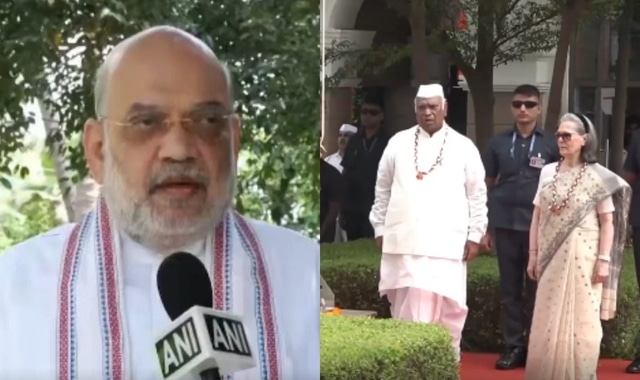
The political storm over Vande Mataram intensified after Union Home Minister Amit Shah accused the Congress of taking an “anti‑national decision” by sticking to its 1937 resolution to sing only the first two stanzas of the national song.
Shah, speaking in Chennai, said the move insulted freedom fighters and revived “appeasement politics” under Rahul Gandhi’s leadership.
Shah alleged that the Congress “sowed the seeds of partition in 1937” by dividing Vande Mataram and claimed the Narendra Modi government had corrected the “historic mistake” by giving the song legal protection under the newly passed Bill.
Adding fuel to the controversy, BJP working president Nitin Nabin branded the Congress the “new Muslim League,” accusing it of formalising “an insult into policy.” He said the decision reflected the party’s hunger for vote‑bank politics.
Opposition leaders hit back. Trinamool Congress MP Kirti Azad challenged Nabin to recite the full six stanzas of Vande Mataram, while Shiv Sena (UBT) MP Sanjay Raut asked Shah and Prime Minister Modi to sing the complete song publicly, noting that the Congress had followed Rabindranath Tagore’s advice in 1937.
Congress MP KC Venugopal defended the party’s position, saying it had been reciting Vande Mataram in this form for over 90 years, guided by leaders like Gandhi, Nehru, and Patel. He accused the BJP of politicising the issue to divert attention from paper leaks, alleged donation theft, and Chinese incursions.
The row underscores how the Vande Mataram Bill, passed recently in Parliament, has become a flashpoint in national politics, with both sides invoking history, symbolism, and patriotism to rally support.