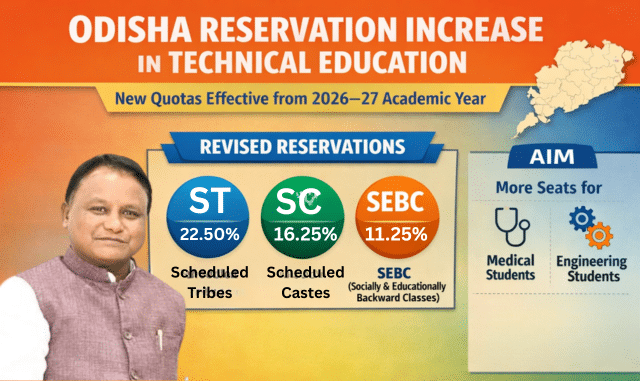
In a transformative step towards social justice, the Odisha government has officially announced a significant increase in reservation quotas for Scheduled Tribes (ST), Scheduled Castes (SC), and Socially & Educationally Backward Classes (SEBC) in all technical and professional education courses.
The decision, cleared in the Cabinet meeting on April 4 and formally notified through a memorandum by the ST & SC Development, Minorities & Backward Classes Welfare Department today, will come into effect from the 2026-27 academic session.
Under the new policy, reservations in engineering, medical, management, IT, nursing, pharmacy, agriculture, veterinary, architecture, and other professional streams will be aligned with the quotas already existing in general higher education and government jobs.
Key Highlights of the New Quotas:
- Scheduled Tribes (ST): Increased from 12% to 22.5%
- Scheduled Castes (SC): Increased from 8% to 16.25%
- Socially & Educationally Backward Classes (SEBC): Newly introduced at 11.25% (previously 0%)
This brings the total reservation in technical education closer to the population proportions — STs constitute 22.85% and SCs 17.13% of Odisha’s population.
Chief Minister Mohan Charan Majhi, who had announced the decision earlier, directed immediate implementation. The move fulfils a long-standing demand that previous governments had failed to address despite years of advocacy.
Officials pointed out a glaring anomaly that existed earlier: while SC/ST/SEBC candidates enjoyed proportional reservation in general degree colleges and government jobs, their access to high-demand technical and medical seats was severely limited. This often resulted in under-representation in prestigious professions despite reservations in recruitment.
The enhanced quota will now apply across all government and government-aided institutions, including universities, affiliated colleges, IITs (state quota), polytechnics, and ITIs offering courses in engineering, technology, medicine, dental, nursing, pharmacy, ayurveda, homoeopathy, agriculture, and allied sciences.
This decision is being widely hailed as a progressive step that will empower lakhs of meritorious yet disadvantaged students and create a more inclusive talent pool for the state’s future development.