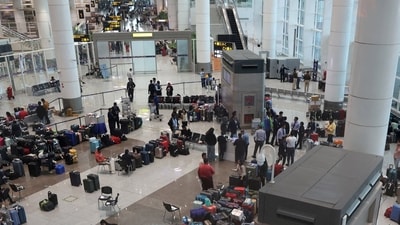
Passengers across India faced widespread travel chaos on Saturday after escalating military tensions between Iran and Israel, alongside reported involvement from the United States, triggered large-scale airspace closures across West Asia.
With hundreds of travellers stranded and limited communication from airlines, international flight operations to and through the Middle East have been severely disrupted. (Photo: Reuters)
What Caused the Disruptions?
The cancellations followed reported military strikes targeting Iran, prompting retaliatory threats and precautionary airspace shutdowns across multiple countries, including the United Arab Emirates, Iraq, Jordan, and Syria.
As a result, global airlines have suspended or rerouted flights passing through key aviation corridors in the Gulf region, affecting both outbound and transit passengers from India.
Bengaluru Airport: Sudden Cancellations Leave Travellers in Limbo
At Bengaluru, passengers at Kempegowda International Airport reported abrupt cancellations for flights to destinations including Abu Dhabi, Bahrain, and Italy.
According to reports by ANI, airline staff cited ongoing geopolitical tensions and regional airspace restrictions as the primary reasons for suspension. Some travellers were informed that operations may resume only after a ceasefire agreement, creating uncertainty for those with urgent travel plans.
Airport authorities issued an advisory stating that a dedicated help desk has been set up at Terminal 2 (Kerbside Level 3) to assist affected passengers with rebooking guidance and updated information.
Mumbai Airport: US- and Europe-Bound Travellers Impacted
Similar scenes unfolded at Mumbai, where operations at Chhatrapati Shivaji Maharaj International Airport were disrupted.
Passengers travelling to the United States and Europe via Gulf hubs reported last-minute cancellations without prior notifications. Several travellers transiting through Bahrain said they received no rebooking clarity from airlines.
Mumbai airport authorities advised passengers to check real-time flight status with respective airlines before proceeding to the airport, as temporary closures across West Asian airspace continue to affect schedules.
Kolkata and Thiruvananthapuram Also Affected
In Kolkata, multiple cancellations impacted passengers heading to Doha, Dubai, Dammam, and Abu Dhabi. Both Indian and international travellers were among those affected.
Meanwhile, Thiruvananthapuram witnessed extensive disruptions at Thiruvananthapuram International Airport, with multiple arrivals and departures cancelled between February 28 and March 1.
444 Flights Cancelled Nationwide
The Ministry of Civil Aviation confirmed that approximately 444 flights were expected to be cancelled on Saturday alone due to airspace restrictions.
The Directorate General of Civil Aviation is coordinating closely with airlines to prioritise passenger safety and ensure adequate assistance at major airports.
Global Impact: Dubai and Gulf Hubs Hit Hard
The disruption extends beyond India. Operations at Dubai International Airport were temporarily affected after regional airspace closures, leaving passengers stranded amid overcrowding and delays.
According to a separate report by PTI, Indian missions in Gulf countries have activated emergency helplines to support stranded nationals.
Globally, more than 1,000 flights have reportedly been cancelled or rerouted as airlines avoid conflict zones. Aviation analysts warn that operational disruptions and fare volatility may persist for several days if tensions continue.
What Travellers Should Do
-
Check airline websites or official airport channels before leaving for the airport.
-
Monitor government travel advisories.
-
Contact airline customer support for rebooking options.
-
Keep travel insurance details handy.
Passengers are advised to remain patient as authorities prioritise safety amid rapidly evolving geopolitical developments.