US President Donald Trump on Friday praised Pakistan’s leadership while his administration voiced support for Islamabad’s “right to defend itself” following a sharp military escalation with Afghanistan’s Taliban government.
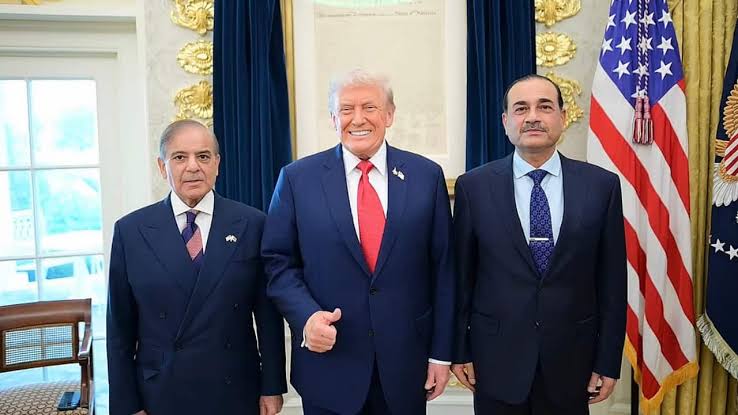
Speaking to reporters, Trump described Pakistan’s Prime Minister Shehbaz Sharif as a “great leader” and the country’s military chief, Field Marshal Asim Munir, as a “great general.”
“I would (intervene). But I get along with Pakistan very, very well,” Trump said, adding that he respects both leaders “a lot.”
Pakistan Launches Airstrikes on Afghan Cities
The remarks came hours after Pakistan announced it had launched airstrikes on multiple locations in Afghanistan under what it termed Operation Ghazab lil-Haq. Islamabad described the action as a response to alleged unprovoked firing by Taliban forces along the border in Khyber Pakhtunkhwa’s Chitral, Khyber, Mohmand, Kurram and Bajaur sectors.
Pakistan’s information minister Attaullah Tarar said military targets were struck in Kabul, Kandahar, and Paktia province.
The Taliban government confirmed the strikes. Spokesperson Zabihullah Mujahid claimed Afghan forces killed 55 Pakistani soldiers and reported 13 Afghan fatalities.
Meanwhile, Pakistan’s military spokesperson, Lieutenant General Ahmed Sharif Chaudhry, stated that 274 Taliban fighters were killed during the operation, with 12 Pakistani troops losing their lives.
US Backs Pakistan’s ‘Right to Defend Itself’
The United States Department of State said it is closely monitoring the situation. Allison Hooker, Under Secretary of State for Political Affairs, expressed US support for Pakistan’s right to defend itself against Taliban attacks following discussions with Pakistan’s Foreign Secretary Amna Baloch.
Hooker also conveyed condolences for lives lost in the recent clashes. While Washington stopped short of calling for an immediate ceasefire, other global powers reacted differently.
Global Reactions Call for De-escalation
The United Kingdom urged de-escalation, China called for a ceasefire, and Iran offered to mediate between the two neighboring countries.
The latest escalation marks one of the most serious flare-ups in months between Pakistan and Afghanistan, whose porous border has long been a source of tension and cross-border skirmishes.
As the situation evolves, diplomatic channels remain active, but the risk of broader regional instability continues to raise international concern.