The Biju Janata Dal (BJD) has issued a stern warning to the central and state governments, threatening widespread street protests if the contentious Polavaram Dam project is not addressed promptly.
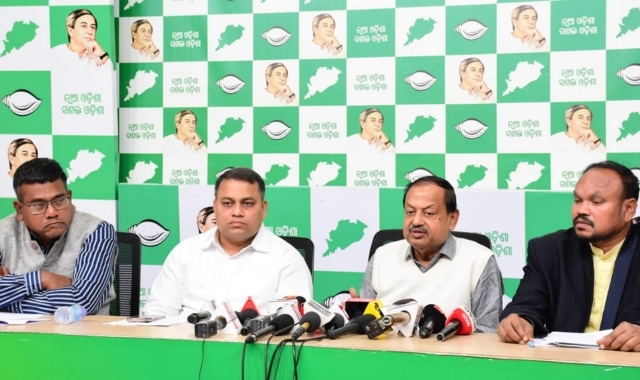
In a press conference at Sankha Bhawan, senior BJD leaders highlighted the project’s potential to displace thousands of primitive tribal groups and submerge hundreds of villages in Odisha’s Malkangiri district.
The BJD leaders, led by Senior Vice President Debi Prasad Mishra, MLA Manohar Randhari, Rajya Sabha MP Subhasis Khuntia, and Media Coordinator Dr. Priyabrata Majhi, accused the “Double Engine Government” of insensitivity toward affected communities. They urged the state’s Tribal Chief Minister to intervene immediately on behalf of Odisha’s tribals.
According to the leaders, a BJD delegation, acting on instructions from party president Naveen Patnaik, visited the affected Motu area in Malkangiri in August 2024 and the Polavaram site in September 2024. Subsequent meetings in December 2024 and August 2025 with the Union Minister for Water Resources, as well as with Environment Minister Bhupendra Yadav, Tribal Affairs Minister Jual Oram, and Central Water Commission officials, raised alarms about submergence risks.
Mishra detailed the project’s history, noting that the Godavari Water Dispute Tribunal originally approved a flood discharge of 36 lakh cusecs, a dam height of 140 feet, and a maximum submergence level of 174.22 feet at the Konta point. However, in 2006, Andhra Pradesh unilaterally increased this to 50 lakh cusecs without consulting Odisha, leading to revised submergence estimates of 220 feet. A subsequent IIT Roorkee study, commissioned by Odisha, projected an even higher 58 lakh cusecs capacity and 232 feet submergence.
The leaders criticised the Ministry of Environment, Forest and Climate Change for repeatedly suspending “Stop Work Orders” without public hearings in Odisha’s affected areas. This prompted Odisha to file Original Suit No. 4/2007 in the Supreme Court, challenging clearances and later amending it after Polavaram was declared a National Project.
Randhari emphasised the devastating impact on primitive tribals’ livelihoods and forest resources, while Khuntia pointed to unanswered parliamentary questions, questioning the project’s transparency. Dr. Majhi questioned the Tribal Chief Minister’s silence, asking about correspondence with union ministers, Andhra Pradesh’s CM, or the Prime Minister over the past 18 months, and accused the BJP of feigning concern for tribals.
The BJD demanded a fresh backwater study by an independent expert, valid environmental clearances for revised parameters, and improved Rehabilitation and Resettlement (R&R) plans. “If the Double Engine Government fails to resolve this, BJD will take to the streets for the rights of Malkangiri’s people,” the leaders concluded.
The Polavaram Dam, aimed at irrigation and power generation in Andhra Pradesh, has long been a flashpoint between states, with Odisha fearing ecological and human costs.
As tensions rise, all eyes are on the governments’ response to avert protests.