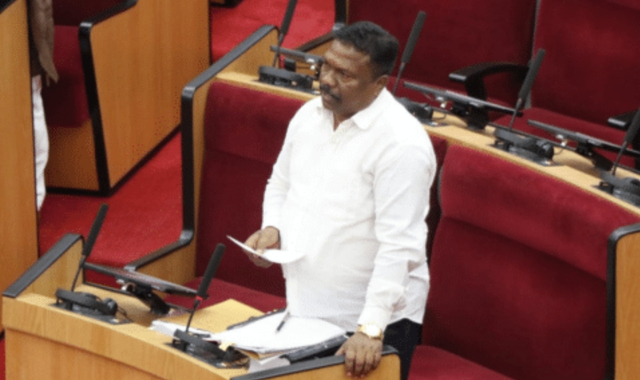
In a resolute commitment to transform rural Odisha, Panchayati Raj and Drinking Water Minister Rabi Narayan Naik declared that the state government will make Odisha free from labour migration (dadana) in the coming days.
Emphasising that village development will not be compromised, and the rights of the poor will not be undermined, the minister invoked Mahatma Gandhi’s vision: “The progress of India lies in the progress of its villages.” He assured that essential services like electricity, water, and roads will be provided to every village.
Speaking during the discussion on the department’s budget demands in the Odisha Assembly on Friday, Minister Naik lambasted the opposition for their empty criticisms, accusing them of failing to deliver government schemes to the poor during their tenure. “The opposition is just making noise without substance. In the previous government, welfare programs never reached the needy,” he said.
A key highlight was the extension of the Mahatma Gandhi National Rural Employment Guarantee Scheme (MGNREGS) for another four years, from the financial year 2025-26 to 2028-29. Under this initiative, workers in 30 migration-prone blocks across nine districts will be guaranteed 300 days of employment. For the first 100 days, in addition to the notified MGNREGS wage, the state government will provide a top-up of Rs 98 per labour day. The remaining 200 days will be funded entirely by the state at an enhanced wage rate.
Naik took a swipe at the former BJD government, pointing out inefficiencies. He cited an example from his recent visit to Nuapada district, where poor residents in one block still lack ration cards, job cards, or labour cards. “When people approached offices, they were told to come back later or couldn’t even meet the officials,” he remarked. He also targeted senior BJD MLA Ranendra Pratap Swain and former minister Arun Sahu, suggesting the latter needs “training” for not addressing these issues during his time in office.
On rural housing, the minister highlighted transparency measures through the “Rural Housing” portal and “Ama Ghara” mobile app, which sends updates on instalments and incentives directly to beneficiaries via SMS. From 2014-15 to date, 39.49 lakh houses have been completed under various schemes. In the current financial year 2025-26, 1,36,905 houses have been built with an investment of Rs 1,915 crore. Under the Pradhan Mantri Awas Yojana (Gramin) [PMAY(G)], Rs 769 crore has been invested to complete 1,21,526 houses. A survey has identified 37.89 lakh families excluded earlier, and eligible ones will be progressively included after verification. Additionally, under the Antyodaya Griha Yojana, 18,635 houses have been completed with Rs 882 crore.
In the drinking water supply, safe and clean water is being provided to rural areas through 25 mega piped water projects, 18,206 single/multi-village pipe water schemes, 5.27 lakh tube wells/sanitary wells, 23,732 solar-powered pumps, and 6,435 solar piped water projects. To ensure universal coverage by 2027, the state is implementing various pipe water schemes with an estimated investment of Rs 54,000 crore, including 207 surface water-based mega piped water supply (PWS) projects costing Rs 35.19 crore, of which 25 are complete and 182 ongoing.
Funding support includes 60% of the 15th Finance Commission’s grant—Rs 1,110.60 crore—for drinking water, rural sanitation, and rainwater harvesting, with the remaining 40% (Rs 740.40 crore) allocated based on local community needs. The 15th Finance Commission has also provided Rs 854.40 crore for 2024-25, while the Fifth State Finance Commission has earmarked Rs 915.09 crore for 2025-26.