
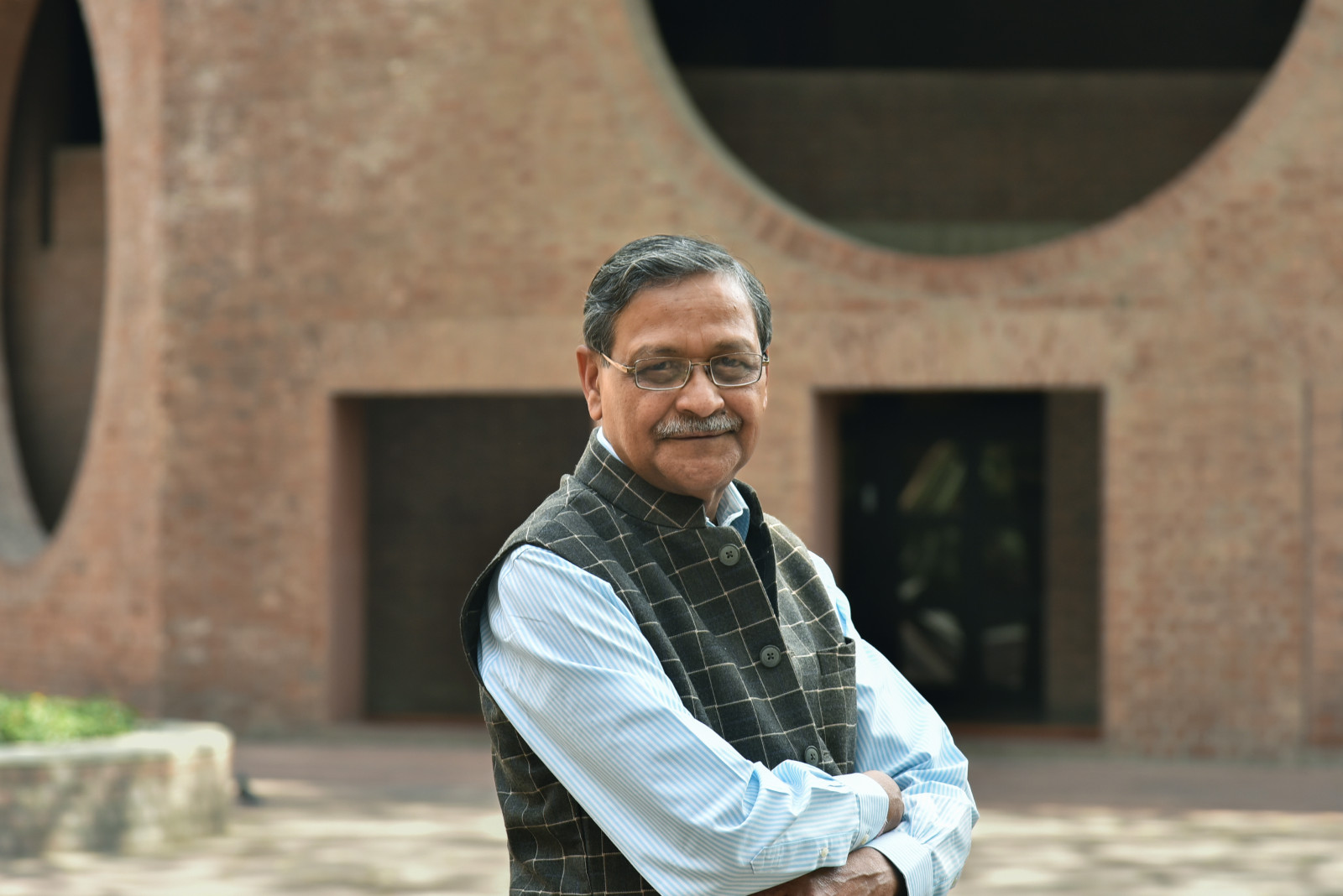
As Indian students increasingly evaluate whether to pursue management studies in India or abroad, IIM Ahmedabad Director Professor Bharat Bhasker has offered a clear perspective: on the metrics that truly matter, IIM Ahmedabad ranks among the top five business schools in the world.
In an in-depth conversation, Professor Bhasker explains why global rankings often overlook India’s strengths, how the institute is preparing learners for an AI-driven future, and why career growth in India today outpaces many Western markets.
Global rankings don’t reflect India’s strengths
Professor Bhasker notes that global rankings emphasise metrics shaped by Western ecosystems rather than emerging economies. One key example is the proportion of international students. Leading global institutes may have 40–65% international enrolment, while IIM Ahmedabad typically has 0.1–0.2%.
“But India needs us to train Indian students,” he says. “We are a growing economy; many Western economies are not. Their challenge is a shortage of domestic students. This parameter benefits them, not us.”
He adds that when measured on geography-neutral indicators—including placement performance, curriculum readiness and learning outcomes—IIM Ahmedabad stands “shoulder-to-shoulder with the world’s top institutions.”
A global alumni legacy spanning six decades
The institute’s impact is reflected in the achievements of its alumni. Professor Bhasker highlights that an IIMA graduate currently serves as the Chief Economist of the World Bank.
IIM Ahmedabad alumni have led multinational corporations, shaped global academic institutions and played influential roles in policy. The current Dean of Harvard Business School and the Dean of Cornell University are both graduates of IIM Ahmedabad. The late C.K. Prahalad, one of the world’s most respected management thinkers, also began his academic journey at the institute.
“These outcomes speak louder than FT or QS rankings,” he says. “Remove irrelevant metrics, and we are comfortably in the top five.”
Why global placements matter less today
International opportunities continue to exist, but many students now prefer to begin and build their careers in India. According to the Director, the country’s accelerating economic growth offers unmatched potential.
“In India, professionals often reach senior roles faster,” he explains. “For instance, reaching associate partner in consulting can happen in seven to eight years. Few regions provide that speed of advancement.”
He emphasises that leadership roles abroad frequently emerge from careers that begin in India, as seen with leaders like Vindi Banga.
Expanding global collaborations and a vision for the Global South
IIM Ahmedabad has established more than 80 international partnerships, spanning Europe, the United States, the UK, Canada and Asia. These include student exchanges, joint programmes and regular faculty collaborations. One IIMA professor teaches at Michigan Ross annually—so consistently that global ranking bodies recently asked to verify his home institution.
The Director says IIMA’s Dubai initiative aligns with a broader vision to deliver a high-quality management model tailored to the Global South.
“Why should world-class education be limited to Harvard or Stanford?” he asks. “We offer the same quality at far more accessible costs. We want Africa, Asia and the Gulf to grow with us.”
What IIMA looks for in applicants
Beyond CAT scores, the institute seeks individuals with diverse experiences and strong analytical capabilities.
“CAT shows aptitude. We look for curiosity, potential and multidimensional thinking,” he states. “We want students who can lead, adapt and look beyond a single perspective.”
Preparing students for an AI-led workplace
With AI and automation transforming global job markets, the Director believes graduates must learn to personalise and work with intelligent tools.
“You should be able to create your own AI assistant—whether from ChatGPT, OpenAI or Gemini—that reflects your writing style and persona,” he says. He expects new career paths to emerge around managing personalised AI systems.
A campus committed to student well-being
IIM Ahmedabad has strengthened its wellness infrastructure with a dedicated mental-wellness board, trained counsellors and an anonymous support platform.
“We tell students that stress is natural—exams, peers and expectations all contribute,” he explains. “Speaking to a counsellor is healthy. We treat it as well-being, not a mental health problem.”
Why IIMA launched its new AI and Analytics programme
The institute’s recently introduced Blended Post Graduate Programme in Business Analytics and AI was created to address gaps in industry preparedness.
“India should have been training AI-ready managers two years ago,” the Director says. “Technology professionals exist, but AI-aware managers are missing.”
The programme is based on five years of research conducted by IIMA’s Centre for Data Analytics and AI.
Rigour preserved in the blended format
Despite the hybrid structure, the Director emphasises that academic rigour remains unchanged. Around 20% of the programme is taught on campus through three immersion modules, while the remaining classes take place online during evenings and weekends. Faculty-led city meets and alumni interactions further strengthen peer learning.
Leadership remains the foundation
Although the curriculum integrates AI and analytics, the Director stresses that IIMA continues to focus on leadership fundamentals.
“We are not running a technology programme,” he clarifies. “Communication, ethics, teamwork and integrity remain at the core. We simply add a new layer—preparing students for an AI-powered business environment.”