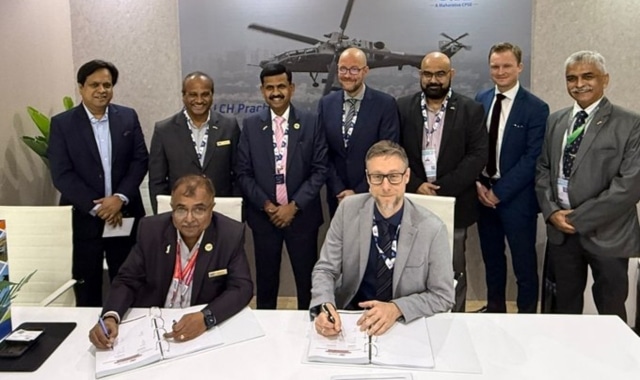
Hindustan Aeronautics Limited (HAL) signed a technology transfer agreement with Germany’s Hensoldt AG at the Dubai Airshow to build LiDAR-based helicopter obstacle guidance and degraded visual environment systems in India.
The pact strengthens India’s indigenous defence ecosystem and opens doors for future export opportunities.
HAL announced that it received Intellectual Property Rights for manufacturing the Obstacle Guidance System (OAS) and Degraded Visual Environment (DVE) technology for helicopters. The company emphasised that this partnership will enhance India’s ability to develop advanced obstacle collision avoidance systems.
DK Sunil, Chairman and Managing Director of HAL, stated that the agreement ensures India develops and owns a LiDAR-based helicopter Obstacle Avoidance System—an advanced capability mastered by only a few countries. He added, “HAL and Hensoldt will collaborate on the design, manufacture, integration, and testing of this system, with the potential for export of OAS and DVE.”
HAL’s Tejas Delivery Timeline
HAL is preparing to deliver the first batch of eight Tejas Mk1A aircraft within the next 24–36 months, according to a Moneycontrol report. Production is expected to remain slower in the initial two to three years but will ramp up as HAL’s production line gains momentum.
In September, HAL signed a ₹62,400 crore contract with the Defence Ministry for the supply of 97 Tejas Mk1A fighter jets. To support this, HAL also signed a contract with General Electric for 113 units of F404-GE-IN20 engines.
HAL’s stock gained 18.9 per cent over the past year. However, it declined by 2.53 per cent in the last month and 2.36 per cent over the past six months, reflecting short-term market pressures despite long-term growth prospects.