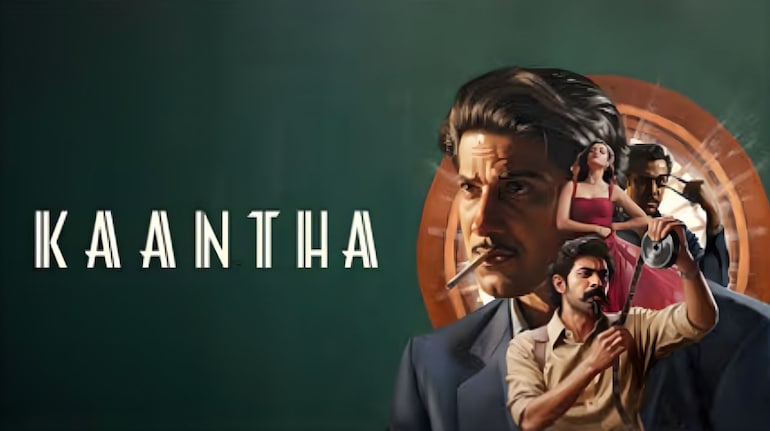
Selvamani Selvaraj’s Kaantha is a retro-styled film that blends romance, ambition, artistic conflict and a murder mystery. With powerful performances by Dulquer Salmaan, Samuthirakani, and Bhagyashri Borse, the film often feels brilliant — even though it doesn’t always reach the emotional depth it aims for.
A Film Within a Film — and a Battle of Egos
Set in 1950s Madras, the story follows filmmaker Ayya (Samuthirakani), who is summoned by studio head Marin (Ravindra Vijay) to revive his stalled horror project Saantha. Ayya believes he has found the perfect lead in Kumari (Bhagyashri Borse), inspired by his own mother.
But there is a catch: he must collaborate with his former protégé, the now-superstar TK Mahadevan (Dulquer Salmaan). Their strained relationship sets up a tense dynamic where creative vision clashes with star power.
What begins as a rivalry soon turns deadly. A murder shakes the studio, and Inspector Phoenix (Rana Daggubati) steps in to uncover the truth as the two men blame each other.
Strong Opening, Stronger Performances
The film opens with a tense, rain-soaked sequence — a mysterious figure, a creaking door, and two gunshots. It hooks you instantly and sets the tone for the noir-inspired story.
Selvaraj then takes us behind the scenes of a fictional film’s making, blurring the line between reality and fantasy. Ayya wants to tell an honest story about betrayal and consequence, while Mahadevan prefers a version that protects his heroic image.
This tug-of-war is compelling, especially when the film mirrors the industry’s own struggles with ego and artistic integrity.
Where the Film Stumbles
Despite its strong setup, Kaantha sometimes loses momentum. The murder mystery doesn’t develop with the urgency it deserves, and the investigation led by Phoenix lacks depth. Rana’s character feels disconnected from the film’s retro world, and the tonal shift becomes jarring.
Some emotional arcs, especially those tied to the murder, could have been better explored. Still, the final act ties the story together with an elegant reveal that brings the narrative full circle.
A Visual and Musical Delight
The film is a treat to watch. Cinematographer Dani Sanchez-Lopez, known for Mahanati, creates breathtaking frames filled with Art Deco aesthetics, warm lighting and dramatic shadows. His use of mirrors and reflections adds depth to Mahadevan’s internal journey.
The music is mixed in impact: while Jhanu Chanthar’s songs don’t always stand out, Jakes Bejoy’s background score greatly elevates the film’s emotional beats.
Dulquer Salmaan Is the Heart of Kaantha
Dulquer delivers one of the strongest performances of his career. His retro look, body language and layered emotional shifts feel authentic to the era. One standout scene requires him to express a range of emotions in seconds — and he nails every beat.
Samuthirakani grounds the film with dignity and emotional weight, while Bhagyashri Borse offers a touching performance that anchors the story.
Final Verdict
Kaantha is ambitious, stylish and filled with passionate performances. But its uneven pacing and underdeveloped mystery stop it from becoming the masterpiece it wants to be.
Still, the film’s highs — especially Dulquer’s performance and the rich visual palette — make it worth watching.
Rating: ⭐⭐⭐/5
A visually stunning drama carried by its performances, even if the story falters in parts.