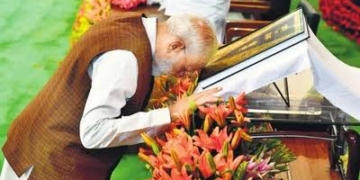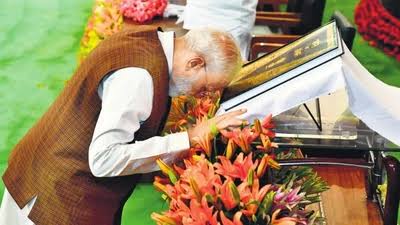
On the occasion of Constitution Day on Thursday, November 26, 2026, Prime Minister Narendra Modi stated in an op-ed published in Hindustan Times that for a nation as diverse as India, the Constitution must resonate far beyond the precincts of Parliament and the courts and deepen its connect with the collective consciousness of citizens, particularly the youth.
Paying tribute to Dr. Rajendra Prasad, Dr. Babasaheb Ambedkar, and all members of the Constituent Assembly—which adopted the Constitution on November 26, 1949—the Prime Minister wrote that the Constitution enabled a child born into modest circumstances without privileges of birth to be entrusted with serving the world’s largest democracy, proving that circumstances of birth no longer determine the limits of an individual’s future.
Welfare Delivery, Constitutional Amendments & Citizen Duties (Kartavya)
-
- Social and Economic Justice Through Governance: Quoting constitutional scholar Granville Austin’s description of the Constitution as “first and foremost a social document,” PM Modi cited a recent World Bank report noting that nearly 50 crore Indians have moved out of poverty. He linked flagship programmes—including PM Awas Yojana, Ujjwala Yojana, Ayushman Bharat, MUDRA, PM-SVANidhi, and digital platforms such as UPI—to advancing dignity, equality, healthcare access, collateral-free credit, and inclusivity.
- Key Reforms, Legal Overhaul & Kartavya: Highlighting constitutional amendments enacted during his government’s tenure, the Prime Minister pointed to the 101st Amendment (introducing GST), the 102nd Amendment (granting constitutional status to the National Commission for Backward Classes), and the 103rd Amendment (providing reservation for Economically Weaker Sections), alongside the release of an updated Constitution in all 22 languages of the Eighth Schedule and the transition from colonial penal laws to the Bharatiya Nyaya Sanhita. He also underscored Kartavya (citizen duties) reflected in mass initiatives like Swachh Bharat and environmental conservation.
“For a nation as diverse as Bharat, with its numerous faiths, languages, customs and schools of thought, it is important that the Constitution have a resonance far beyond the precincts of Parliament and the courts. Our endeavour has been to deepen its connect with the collective consciousness of our people, especially our youth and strengthen the spirit of unity essential to India’s bright future.”
— Narendra Modi, Prime Minister of India (Constitution Day Op-Ed, November 26, 2026)
Critique of Past Amendments, Article 356 & Opposition Conduct
In the op-ed, PM Modi criticised past governments that governed India for five decades, pointing to 75 years since the First Amendment of 1951, 50 years since the 42nd Amendment during the Emergency, the 38th and 39th Amendments, and the repeated imposition of Article 356 nearly a hundred times to dismiss elected state governments. He also cited the 2019 abrogation of Articles 370 and 35A in Jammu and Kashmir and the elimination of Naxalism this year as steps that extended constitutional rights to marginalised communities.
Targeting the principal Opposition party, PM Modi criticised proposals to alter OBC quotas for religion-based reservations, alleged obstruction over women’s legislative representation earlier this year, and remarked that the leading Opposition party had acted more as an “Avrodh Paksh” (obstructionist) than a “Virodh Paksh” (opposition). Concluding with a call toward Viksit Bharat by 2047, he urged citizens to adopt “India First” in thought and “Kartavya” in action.