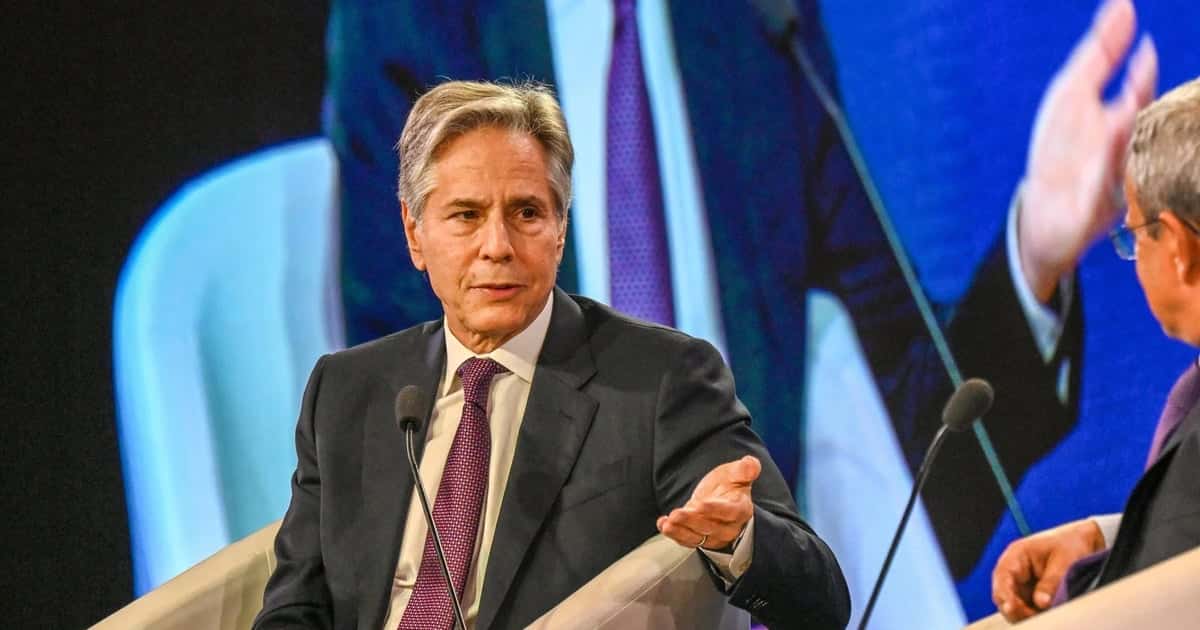
Former US Secretary of State Antony Blinken has acknowledged that he misjudged the duration of the ongoing conflict with Iran, admitting he had expected the war to conclude far sooner.
Speaking in New Delhi at the 24th Hindustan Times Leadership Summit (HTLS) on November 14, 2026, in conversation with former Indian ambassador Jawed Ashraf, Blinken outlined three mounting pressures confronting President Donald Trump—“markets, munitions, midterms”—alongside the political difficulty of accepting a diplomatic off-ramp.
Elaborating on the “three Ms,” Blinken pointed to rising domestic costs for gasoline, diesel, and fertiliser hitting American households, a significant depletion of US arms and missile stockpiles, and heavy Republican losses in the November 3 midterm elections, in which Democrats captured control of both the House and the Senate amid voter frustration over inflation, governance, and the Iran war.
Trump’s Off-Ramp Dilemma & Strait of Hormuz Leverage
- Cost of Acknowledging Limits: What he initially “did not factor in,” Blinken noted, was the political price of exiting the conflict. While a diplomatic off-ramp remains viable—potentially yielding a nuclear arrangement no tighter than the 2015 nuclear deal Trump previously abandoned—taking it requires acknowledging that regime-change or maximalist goals have not succeeded and making some accommodation with Tehran.
- Strait of Hormuz as a New Bargaining Chip: Blinken stressed that disruption along the Strait of Hormuz—a critical global oil transit chokepoint—”was not a problem before this war started,” but has now become a central issue that any settlement will have to address, meaning a deal would almost certainly grant Iran concessions he described as “a toll that’s not called a toll”.
“While there was clearly an off-ramp for the president, and it remains, the problem with the off-ramp is an acknowledgement that he’s not succeeded. That is because it requires some kind of accommodation with Iran, and that’s what he refuses to acknowledge.”
— Antony Blinken, Former US Secretary of State
Stalemate Odds & Vertical vs. Horizontal Escalation
Assessing the trajectory ahead, Blinken estimated at least a 50% probability that the current stalemate persists, while putting the risk of major escalation at 20% to 25%—a scenario he warned would be “very, very dangerous”.
He contrasted both sides’ military leverage: while the United States holds overwhelming capacity for vertical escalation through heavier bombing campaigns, Iran specialises in horizontal escalation—spreading instability across multiple fronts by targeting regional partners, Gulf infrastructure, and American bases directly or via proxy networks, an asymmetry Blinken warned does not favour Washington.