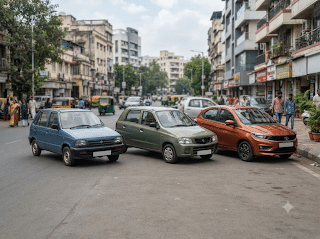
Indian cities did not merely influence small car design; they served as the primary blueprint. Narrow lanes, exceptionally tight parking spaces, and heavy traffic that crawls far more than it flows created a challenging brief that no global vehicle platform could answer seamlessly off the shelf.
Over three decades, manufacturers responded by fundamentally reshaping dimensions, gearing, suspension tuning, and even seating positions around one question that mattered more than any other: how does this vehicle actually behave at crawling city speeds?
City Traffic Became the Design Brief
Early Indian small cars essentially had one overriding priority, which was fuel economy. For a long time, that single metric dictated engineering decisions.
By the mid-2000s, that single priority had fractured into three measurable targets: turning circle, kerb weight, and low-speed driveability. Engineers stopped benchmarking primarily on highway stability and started measuring how many steering inputs it took to exit a crowded market lane, which is a genuinely different engineering discipline.
That shift explains why a second hand Alto 800 for daily city driving still appears on buyer shortlists years after newer rivals have launched. Its 796cc engine produces modest output, but the low kerb weight means the power-to-weight equation works perfectly below 50 km/h without asking anything heroic from the driver.
A tight turning circle allows a U-turn in spaces where larger vehicles typically require a complex multi-point manoeuvre. Here is what the pattern shows across a decade of market launches: cars grew longer and heavier as safety norms evolved, yet manufacturers fought hard to keep the turning circle flat. Length increased, but urban agility was not sacrificed. That is not an accident; it is the result of engineers treating city geometry as a hard constraint rather than a preference that could be negotiated away late in the development programme.
Engines Tuned for Second Gear
Urban driving cycles involve long idle periods, frequent clutch work, and rarely accessing more than a third of the available engine speed. Manufacturers responded by tuning engines for low-end torque rather than peak power output, ensuring the car keeps pulling through crawling traffic without demanding constant downshifts.
Three key technologies followed directly from this specific usage pattern:
- Automated manual transmissions (AMTs) removed clutch effort at a price point well below a conventional torque converter automatic.
- Idle start-stop systems cut fuel consumption during signal waits, where city cars can sit stationary for surprisingly long stretches.
- Variable valve timing allowed a single engine to remain highly efficient at crawling speeds while retaining enough usable power for quick overtakes.
Each carries a trade-off worth knowing. AMT units can exhibit a slight pause between shifts, which drivers typically learn to modulate with throttle inputs over time. Start-stop systems place extra cyclic load on the battery and starter motor, which can sometimes shorten their replacement intervals. Furthermore, lighter kerb weights assist city economy but can make the car feel less planted at higher speeds. This is rarely an issue in dense urban centres but can become more apparent during sustained open-road driving.
Reading City Wear on a Used Small Car
Urban usage leaves a distinct mechanical signature, and the wear patterns differ significantly from highway use. A vehicle subjected to constant heavy urban running will generally show more clutch and suspension wear than a highway-driven car with a similar or even higher odometer reading.
Anyone comparing used hatchback cars should inspect these specific areas carefully:
- Clutch bite point: If the clutch engages in the top third of pedal travel, a replacement is likely near. The cost of this varies considerably depending on the specific model.
- Suspension components: Potholes and speed breakers accelerate wear on bushes and strut mounts. Listen for knocking noises over uneven surfaces at low speed with the windows down.
- AC cooling at idle: City cars run the compressor for hours while stationary. Weak cooling in traffic but strong cooling while moving usually points to a tired condenser fan, which is generally an affordable fix if caught early.
- AMT actuator behaviour: Jerky or delayed engagement in first and second gear can indicate actuator wear, which requires proper diagnostic attention.
- Tyre edge wear: Uneven inner or outer edge wear often indicates alignment neglect, a common issue on cars that navigate broken urban roads daily.
The standard advice is often to judge a used car primarily by its odometer. In practice, service history matters more, especially for vehicles used almost exclusively in the city. Urban driving compresses engine operating hours into fewer total kilometres, which is why small cars reward owners who treat maintenance intervals diligently. Cars used predominantly in city traffic can age mechanically faster than their mileage suggests, making a thorough pre-purchase inspection essential.