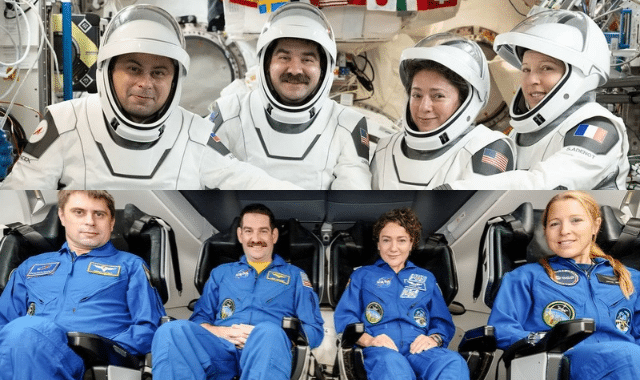
Four Expedition 75 crew members spent their final full day aboard the International Space Station on Tuesday, stowing personal items, experiment samples, and cargo inside a SpaceX Dragon spacecraft ahead of an early Wednesday departure.
NASA astronauts Jessica Meir, the mission commander, and Jack Hathaway, the pilot, along with ESA astronaut Sophie Adenot and Roscosmos cosmonaut Andrey Fedyaev, have completed 237 days in orbit and are scheduled to undock from the Harmony module’s space-facing port at 8:05 a.m. EDT.
The Crew-12 quartet launched in early 2026 and has supported a continuous sequence of station maintenance, cargo operations, and scientific investigations. On their last day they prepared fluid-loading drink bags with salt tablets, a standard step that helps the body readjust to gravity during the return. NASA and SpaceX recovery teams are positioned for a parachute-assisted splashdown in the Pacific Ocean at 11:34 a.m. EDT on Thursday, followed by retrieval and medical checks.
Their departure leaves seven residents on the station. NASA’s SpaceX Crew-13 arrived on October 1 and has already begun research duties that will continue through spring 2027. Remaining long-duration crew members include NASA flight engineer Anil Menon and Roscosmos cosmonauts Pyotr Dubrov, the current station commander, and Anna Kikina, who arrived in July.
Science continues without pause. Recent work has focused on human health in microgravity: blood-sample processing to study spaceflight-associated clotting risk, sleep and saliva monitoring under the RelaxPro investigation, ultrasound vein scans, respiratory measurements with wearable acoustic sensors, and exercise-cycle tests that track heart and breathing rates. Cosmonauts also configured hardware for the Teledroid study, which evaluates body-worn controls for future robotic operations.
Live NASA+ coverage of hatch closure is set to begin around 6 a.m. EDT Wednesday, with undocking coverage resuming at 7:45 a.m. Splashdown coverage starts at 10:20 a.m. Thursday.
The handover marks a routine but tightly timed crew rotation that keeps the station continuously occupied while returning long-duration samples and crew members to Earth.