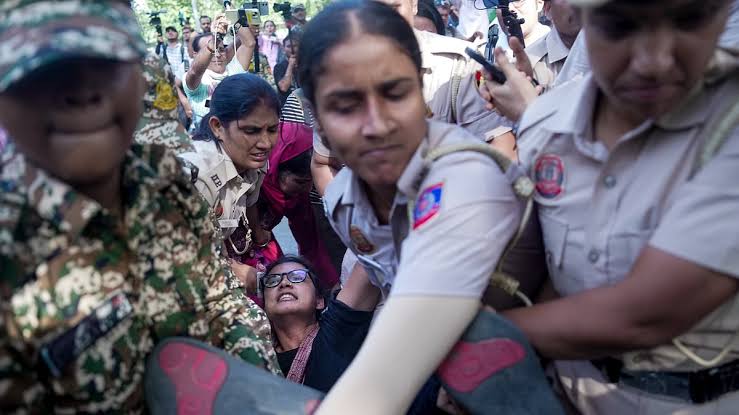
Delhi Police personnel deployed at Jantar Mantar during recent protests against Chief Election Commissioner Gyanesh Kumar did not wear name tags, with officials describing it as a deliberate measure to prevent officers from being identified and targeted on social media.
The protests were linked to allegations of irregularities in the Special Intensive Revision (SIR) of electoral rolls. Police officials familiar with the deployment said the decision was influenced by the experience of the July 20 CJP march, when several personnel were allegedly identified and targeted online following clashes.
Why police personnel removed name tags
Officials said the issue was discussed during internal reviews of crowd management after the July protests. According to a police officer aware of the deliberations, some officers and their families were subjected to online targeting after personnel were identified in social media posts, memes and videos.
The officer said some personnel reported that their families were also mentioned or targeted in social media discussions and workplace circles.
Following the reviews, senior officers reportedly assured personnel that they would not face action for removing name tags while performing their duties within the law.
While many senior Indian Police Service officers retained their tags at Jantar Mantar, several junior personnel were allowed to operate without them, officials said.
Police face criticism over decision
The absence of name tags drew criticism during the protests, particularly because Delhi Police and central armed police forces had faced allegations of excessive force during the July demonstrations.
Videos from the earlier protests had shown police and security personnel confronting protesters. Police maintained that force was used after demonstrators turned violent and attempted to breach multiple layers of barricades.
The CJP march in July had followed weeks of protests and a hunger strike at Jantar Mantar. Demonstrators had attempted to march towards Parliament while demanding the resignation of then Union Education Minister Dharmendra Pradhan over alleged examination paper leaks.
Police used tear gas and baton charges to disperse the crowd after protesters attempted to breach barricades.
Influencers also under police watch
Police officials also said they had identified individuals posing as media personnel and using mobile phones to record officers during the protests.
An officer involved in the security arrangements said some influencers were conducting live sessions, recording police personnel and questioning them on camera, with videos later being used for memes or social media content.
Police personnel were therefore instructed to remain composed when approached by people recording on phones, officials said.
The Delhi Police also checked the identity cards of people claiming to be reporters during the protests.
Security preparations tightened
In the run-up to the protests against Kumar, Delhi Police and central armed police forces conducted anti-riot drills and training sessions.
The preparations followed criticism over the handling of the July protests. Some police and security personnel were captured on camera allegedly slapping, assaulting or tripping protesters, leading to questions over the use of force.
Police personnel were subsequently trained to maintain composure while dealing with protesters, influencers and others recording the proceedings.
The practice of limiting visible identification of security personnel is also used in certain conflict-affected areas, including parts of Jammu and Kashmir, the Northeast and Left Wing Extremism-affected regions, where the identities of personnel may be concealed to reduce the risk of targeting.
The decision to remove name tags at Jantar Mantar has, however, renewed debate over police accountability and the balance between protecting personnel from online targeting and ensuring transparency during public demonstrations.