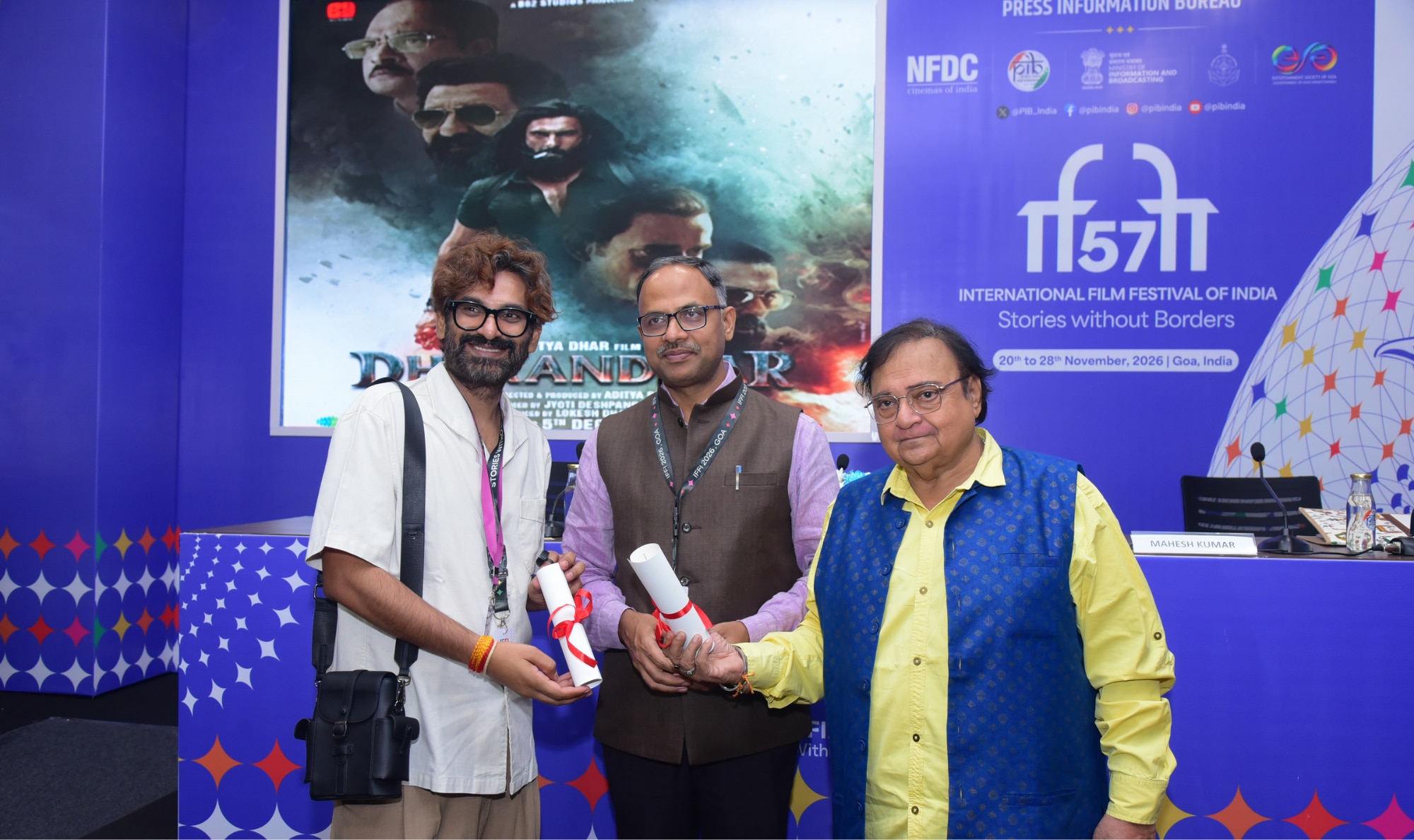
Good acting looks effortless on screen, yet it rarely happens by accident. At the 57th International Film Festival of India (IFFI), veteran actor Rakesh Bedi pulled back the curtain on his creative process for Aditya Dhar’s Hindi feature Dhurandhar, which opened the Mainstream Cinema Feature Film category in the Indian Panorama section.
Speaking at the festival’s Media Centre on day two alongside production designer Saini S. Johray—in a session moderated by Additional Director General Shri Mahesh Kumar of the Ministry of Information & Broadcasting—Bedi focused on what separates a lived-in character from a surface-level impression.
Beyond Mimicry: Inside Jamil Jamali
Playing Jamil Jamali in Dhurandhar, Bedi pointed to layered writing as a vital anchor in modern cinema. Backed by decades on stage, he stressed that theatre remains the bedrock of his discipline, pairing rigorous research with an instinct for what the scene actually requires.
“A character’s actions must be driven by the demands of the scene, making the performance a complete character portrayal rather than an exercise in mere mimicry.”
Even comic and dramatic timing, Bedi noted, are deliberate choices woven into the script and character arc rather than lucky flukes. When asked how he shifts gears between moods—or whether he rehearses in front of a mirror—he offered a pointed piece of advice for aspiring performers: skip the mirror. Watching yourself mid-scene makes objective self-assessment tough and can hold back an actor’s growth. Focus instead on the character’s inner life; once that psyche clicks, speech, reactions, and emotional turns follow naturally.
Five Decades of Shift in Reach
Looking back over a five-decade career spanning classics like Ek Duuje Ke Liye, Tirangaa, and Chashme Buddoor, Bedi reflected on how much the audience landscape has changed. While older films drew massive affection, their reach moved at the pace of traditional distribution. Today, digital platforms and social media put a performance within a single click of viewers worldwide.
Reconstructing a World on Over 40 Sets
While Bedi mapped the emotional terrain, production designer Saini S. Johray broke down the physical scale of Dhurandhar. With no direct access to locations in Pakistan, Johray and the design crew built more than 40 practical sets from the ground up.
To get the visual texture right, Johray turned to news archives, local gang-war accounts, urban detail studies, and Google Maps—turning the absence of physical access into a test of research and craft.
Across its second-day conversations, the 57th IFFI leaned into the mechanics behind the screen, reminding audiences that what lands in a single frame often starts in notebooks, rehearsals, and architectural blueprints.