The city that never sleeps was forced awake by the sound of automatic gunfire.
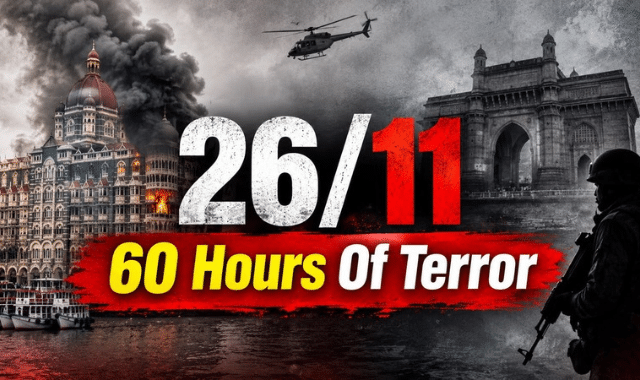
On the night of 26 November 2008, ten heavily armed terrorists from Lashkar-e-Taiba slipped into Mumbai by sea and tore the heart out of India’s financial capital. What followed was not a single explosion or a fleeting ambush. It was a 60-hour siege—coordinated, cold-blooded, and designed to maximise terror.
The Taj Mahal Palace Hotel, the Oberoi Trident, Chhatrapati Shivaji Maharaj Terminus and Nariman House became killing grounds. Guests, diners, commuters and staff were hunted through corridors and platforms while the world watched in horror.

For nearly three days the city held its breath. Hostages were taken. Rooms burned. The sound of grenades and sustained fire echoed across landmarks that had symbolised Mumbai’s confidence and glamour. By the time the last shots faded, 166 people were dead and more than 300 lay wounded. Nine terrorists were killed. The tenth, Ajmal Kasab, was dragged from the chaos alive—his capture later proving the attack’s foreign origin beyond doubt.

Yet the story of 26/11 is not only one of calculated slaughter. It is the story of the men and women who refused to let the city die. Local police, often outgunned and outmatched, charged into the gunfire. National Security Guard commandos and Marine Commandos fought room-to-room in darkness and smoke.
Some paid with their lives so others could live. Their sacrifice is not abstract history; it is the reason Mumbai still stands, scarred but unbroken. Eighteen years later, the nation still measures its resolve against the courage those personnel showed when the night was darkest.
Today, on the 18th anniversary, flowers are laid, and names are spoken aloud. Leaders and citizens gather to honour both the innocent who never returned home and the security personnel who made the supreme sacrifice. The grief remains raw because the wounds never fully closed. The memory is kept alive not for mourning alone, but as a permanent warning.
That warning has shaped India’s security posture. The zero-tolerance doctrine that hardened after 26/11 found its most comprehensive expression in February 2026 with the unveiling of PRAHAAR—India’s first National Counter-Terrorism Policy and Strategy.
Built on seven pillars—prevention, swift and proportionate response, aggregation of national capabilities, adherence to human rights and the rule of law, attenuation of the conditions that breed terror, international cooperation, and recovery through whole-of-society resilience—PRAHAAR is designed to ensure the next attack never reaches the scale of 26/11.
It institutionalises real-time intelligence sharing, tightens the chain of command between state forces and specialised units, and drives the fight against radicalisation and terror financing down to the last police station. The message is unmistakable: the era of reactive defence is over. India will anticipate, disrupt and, if necessary, strike back with coordinated force.
Eighteen years on, the Taj still stands, the trains still run, and the city still lights up at night. But the silence on this anniversary is heavy. It carries the weight of 166 lives, the echo of gunfire, and the unyielding promise that those who tried to break Mumbai will never be allowed to succeed again. The heroes of 26/11 did not die in vain. Their final stand continues—every day the nation stays vigilant, every day it strengthens the shield they helped forge with their blood.