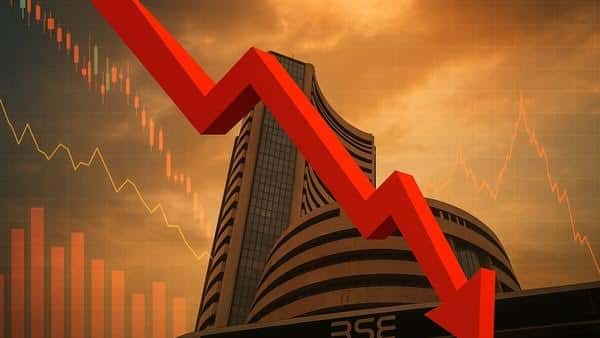
Indian stock markets witnessed a dramatic reversal on Friday after benchmark indices erased early gains and ended sharply lower amid heavy selling in the final hour of trade.
The BSE Sensex plunged 1,092.06 points to close at 74,775.74, while the NSE Nifty dropped 359.40 points to settle at 23,547.75.
The sharp fall came after markets traded in positive territory for most of the session before sentiment turned negative after 3 pm.
Why Did the Stock Market Fall Today?
Market experts linked the sudden sell-off to multiple concerns, including profit-booking by investors, continued foreign institutional investor (FII) outflows, global geopolitical uncertainty and worries over a weaker monsoon forecast.
The India Meteorological Department’s latest warning of below-normal rainfall this year added to concerns about inflation, rural demand and economic growth.
Investors also remained cautious due to tensions in West Asia and rising uncertainty in global markets.
Sectors Under Pressure
Selling pressure was seen across several major sectors.
Financial stocks, FMCG companies and metal shares emerged among the biggest losers during the late-session crash. Although information technology stocks showed some resilience earlier in the day, they failed to offset the broader market weakness.
Large-cap stocks witnessed intense volatility as traders rushed to reduce risk exposure before the weekend.
One of the Biggest Falls in Recent Weeks
Friday’s decline marked one of the steepest single-day falls for Indian benchmark indices in recent weeks. The sharp reversal highlighted the fragile market sentiment despite positive global cues earlier in the trading session.
Analysts said investors are becoming increasingly cautious due to a mix of domestic and international risks.
What Investors Will Watch Next
Market participants will now closely track several key factors in the coming days, including:
- Foreign institutional investor activity
- Crude oil price movements
- Geopolitical developments
- Monsoon progress across India
- Inflation and economic data
Experts believe volatility may continue in the near term as investors react to changing global and domestic conditions.
Despite the sharp correction, analysts advise long-term investors to remain focused on fundamentals and avoid panic-driven decisions during volatile trading sessions.