
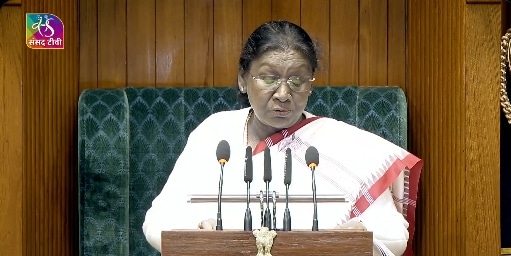
President Droupadi Murmu opened the Budget session with a strong emphasis on inclusive growth, rural employment, and national security. She announced the Viksit Bharat-G RAM G law, guaranteeing 125 days of employment in villages, a move that sparked opposition protests demanding its withdrawal.
The President underscored India’s push for self-reliance in critical minerals, expansion of the “Make in India” initiative, and highlighted India’s rise as the world’s third-largest startup ecosystem. Plans to establish 10 new semiconductor factories and defense production crossing ₹1.5 lakh crore were also revealed.
On youth empowerment, Murmu noted that 1 million young people are being trained in AI, while 1,000 ITIs have been upgraded to meet future skill demands. She also emphasized women-led development, celebrating over 2 crore “Lakhpati sisters” and setting a target of 3 crore.
National security featured prominently, with the suspension of the Indus Water Treaty framed as part of India’s fight against terrorism, alongside the launch of Mission Sudarshan Chakra to strengthen defense capabilities.
Farmers’ welfare was declared the government’s top priority, with record food grain and horticulture production projected for 2024–25. The President also highlighted that 95 crore Indians are now covered under social security, with growing opportunities in the green sector.
Her address set the tone for a Budget session focused on economic resilience, innovation, and inclusive development, amid spirited parliamentary debate.