
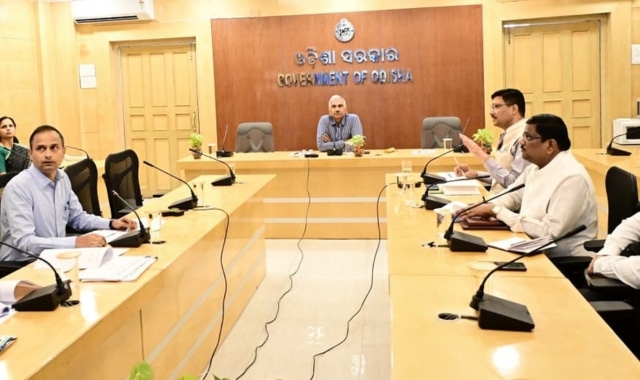
The first state-level meeting to oversee the implementation of the Pradhan Mantri Dhan-Dhaanya Krishi Yojana (PM-DDKY) in Odisha was held today at the conference hall of Lok Seva Bhawan, chaired by Chief Secretary Manoj Ahuja.
The Central Government launched the PM Dhan-Dhaanya Krishi Yojana on October 11, 2025, targeting 100 districts across India with low agricultural productivity, moderate crop intensity, and below-average farmer creditworthiness. In Odisha, four districts — Malkangiri, Nuapada, Kandhamal, and Sundargarh — have been selected under the scheme.
Under the scheme, 36 existing Central Government schemes from nine different ministries will be implemented in convergence mode in these districts. These include 18 schemes from the Agriculture & Farmers Empowerment Department, 8 from Fisheries & Animal Resources Development, 3 from Cooperation, and one each from Water Resources, Industries, Rural Development, Skill Development & Technical Education, MSME, and OUAT.
The meeting discussed in detail the convergence of these schemes and their effective implementation. The Agriculture & Farmers’ Welfare Ministry of the Government of India will play a key coordinating role with various ministries, while NITI Aayog will regularly review progress.
Key objectives of the scheme include promoting crop diversification, encouraging sustainable farming practices, strengthening post-harvest storage at panchayat and block levels, expanding irrigation facilities, and enhancing farmers’ access to long- and short-term credit to boost their economic growth.
The meeting, convened by the Agriculture & Farmers Empowerment Department, was attended by Principal Secretary Dr. Arabinda Kumar Padhee, Director of Agriculture Shubham Saxena, and senior officials from related departments. District Collectors of the four selected districts joined virtually and shared updates on preparatory activities.
A state-level committee has already been constituted under the chairmanship of the Chief Secretary, with Additional Chief Secretaries, Commissioners, Secretaries, and NABARD representatives as members. District-level committees, chaired by respective Collectors and including departmental officers, farmer representatives, and other stakeholders, have also been formed. The state committee will regularly monitor implementation, while district committees will oversee ground-level execution.
Experienced Indian Administrative Service officers from various Central ministries have been appointed as Central Nodal Officers for the districts, tasked with coordinating between the Centre, State, and NITI Aayog, reviewing district action plans, and assessing on-ground progress.
Principal Secretary Dr Padhee emphasised that the scheme will accelerate development in tribal-dominated, aspirational districts and blocks by integrating various departmental programmes. Director Saxena presented details of the schemes to be converged.
Chief Secretary Manoj Ahuja described the programme as an opportunity to expand development activities in the targeted districts and sought full cooperation from Central secretaries, NITI Aayog, and state and district officials for its successful implementation.