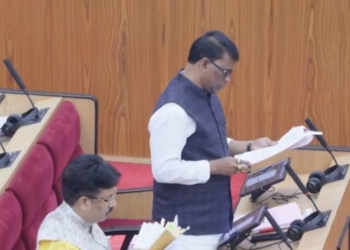

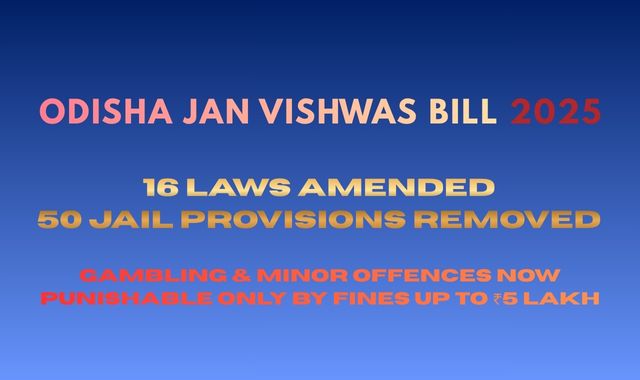
The Odisha Legislative Assembly on 2 December 2025 passed the Odisha Jan Vishwas Bill, 2025 – a landmark legislation that decriminalises minor and procedural offences across 16 state laws, replacing imprisonment with graded monetary penalties and aligning Odisha with the Centre’s Jan Vishwas (Amendment of Provisions) Act, 2023.
Inspired by the national framework already adopted by states like Madhya Pradesh, Chhattisgarh, Gujarat and Tripura, the bill aims to reduce compliance burden, eliminate fear of criminal prosecution for technical lapses, and create an investor-friendly and citizen-centric environment.
Key Highlights of the Bill
- – Amends 16 laws belonging to 9 departments
- Identifies 161 provisions for rationalisation
- Removes or decriminalises 50 imprisonment clauses
- Converts 111 existing fines into civil monetary penalties
- Serious offences involving deliberate fraud, public health, environment or society remain fully criminal and punishable under the Bharatiya Nyaya Sanhita
Offences Re-categorised into Two Groups
**Category A** covers minor procedural lapses, such as delay in filing returns or failure to furnish required information.
**Category B** includes slightly more serious compliance-based or technical violations, such as operating without registration or non-renewal of a licence.
The new penalty structure, based on the severity of the earlier imprisonment provision, is as follows:
- For offences that previously carried imprisonment of up to 3 months:
Category A offenders will now pay ₹5,000 to ₹25,000, while Category B offenders will pay ₹25,000 to ₹75,000. - For offences that previously carried imprisonment of 6 months to 1 year:
Category A penalty ranges from ₹25,000 to ₹1 lakh, while Category B penalty ranges from ₹75,000 to ₹2 lakh. - For offences that previously carried imprisonment of 1 to 3 years:
Category A offenders will be fined ₹1 lakh to ₹2 lakh, whereas Category B offenders will face ₹2 lakh to ₹5 lakh.
In every case, Category B (technical/compliance-based) violations attract a higher penalty slab than Category A (purely procedural) violations, ensuring the punishment remains proportionate and deterrent without resorting to jail terms for minor or inadvertent breaches.
List of 16 Laws Amended
1. The Odisha Nurses and Midwives Registration Act, 1938
2. The Odisha Municipal Act, 1950
3. The Odisha Prevention of Gambling Act, 1955
4. The Odisha Agricultural Produce Markets Act, 1956
5. The Odisha Town Planning and Improvement Trust Act, 1956
6. The Odisha Shops and Commercial Establishments Act, 1956
7. The Odisha Electricity (Duty) Act, 1961
8. The Odisha Kendu Leaves (Control of Trade) Act, 1961
9. The Odisha Co-operative Societies Act, 1962
10. The Odisha Industrial Establishments (National & Festival) Holidays Act, 1969
11. The Odisha Development Authorities Act, 1982
12. The Odisha Fire and Emergency Services Act, 1993
13. The Odisha Municipal Corporation Act, 2003
14. The Odisha Value Added Tax Act, 2004
15. The Odisha Labour Welfare Fund Act, 2005
16. The Odisha Excise Act, 2008
Four Core Reforms Introduced
1. Decriminalisation of minor offences – jail terms replaced with civil penalties
2. Administrative adjudication mechanism for quick resolution
3. Conversion of criminal “fines” into “civil monetary penalties”
4. Proportionate, predictable and deterrent penalty structure
The bill explicitly states that intentional cheating, threats to public health, environment or society will continue to attract full criminal prosecution and imprisonment under existing laws including the Bharatiya Nyaya Sanhita, 2023.
Expected Benefits
- Faster delivery of government services and grievance redressal
- Reduced burden on courts from petty criminal cases
- Enhanced investor confidence and improved Ease of Doing Business ranking
- Greater Ease of Living for citizens by removing fear of jail for genuine procedural mistakes
- Stronger trust-based governance model
Industries Minister Sampad Chandra Swain, who piloted the bill, described it as a “historic legal reform” that will accelerate Odisha’s journey towards a “Developed Odisha” (Viksit Odisha) by fostering good governance, citizen-centric laws and investor confidence.