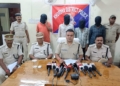


The National Investigation Agency (NIA) has made another significant breakthrough in the November 10 Red Fort blast case, arresting a second “active co-conspirator” within 24 hours. The move further tightens the agency’s investigation into what officials describe as a sophisticated, multi-state “white-collar terror module.”
The latest arrest involves Jasir Bilal Wani, also known as Danish, a 20-year-old from Qazigund in south Kashmir’s Anantnag district. According to the NIA, Wani allegedly provided critical technical support to the group, including modifying drones and attempting to fabricate rocket-type devices, enhancing the module’s operational capability.
Officials said Wani worked closely with Umar un-Nabi, the suicide bomber who drove the explosive-laden vehicle that detonated near the Red Fort. Wani’s technical skills were reportedly used to strengthen the module’s strike potential.
This arrest follows Sunday’s detention of Amir Rashid Ali, a plumber from Kashmir and owner of the vehicle Nabi was using at the time of the blast.
Details of the Arrest and Family Tragedy
Wani, a Bachelor of Science student at Degree College Lawdora, was first detained by Jammu & Kashmir Police before being handed over to the NIA. Authorities said he lived next to Dr Adeel Ahmad Rather, another accused previously arrested for his alleged involvement.
In a tragic turn, Wani’s father, Bilal Ahmad, attempted self-immolation on Sunday after he was reportedly unable to meet his detained sons. He later succumbed to his injuries. Wani had been taken into custody on Friday, along with his uncle, Nazir Ahmad Wani, a physics lecturer.
Links to Module’s Operations
Investigators say Wani met several module members at a mosque in Kulgam before travelling to a rented accommodation near Al-Falah University in Faridabad, which is believed to have been used to assemble parts of improvised explosive devices (IEDs) and other weapons.
Officials further allege that Nabi had tried to indoctrinate Wani into becoming a suicide bomber, a plan Wani reportedly abandoned due to his family’s difficult financial situation and religious objections to suicide.
Encrypted Communications and Arms Movement
According to NIA officials, the probe has exposed a well-structured network operating through encrypted communication channels on Signal, using special characters to evade detection. Several individuals—including Dr Muzammil Shakeel Ganaie, Adeel Ahmad Rather, Muzaffar Rather, and Molvi Irfan—were part of this encrypted coordination group.
The investigation accelerated after a weapons consignment was recovered from the vehicle of Dr Shaheen Shahid, which included a foreign-made rifle and a pistol. Officials say this arms trail dates back to 2024, when Umar allegedly procured the weapons and handed them over to Molvi Irfan, a cleric suspected to be central to recruitment.
Clear Division of Roles Within the Module
Authorities have identified a clear division of responsibilities within the group. Three medical professionals—Muzammil, Shaheen, and Adeel—were allegedly responsible for financial support, while Islamist extremist Umar focused on preparing young men for potential suicide missions.
Multiple meetings and weapons transfers involving Adeel, Umar, Irfan, and other members from late 2023 highlight what investigators describe as a trusted inner circle designed to avoid detection.
Ongoing Probe and More Arrests Expected
The arrest of Amir Rashid Ali has provided further insight into the module, with investigators stating that Ali helped plan the vehicle-borne IED attack and travelled with other accused multiple times across Faridabad and Kashmir.
So far, the NIA has examined 73 witnesses, including survivors of the blast. Officials say more arrests are likely across India, with coordinated raids underway in Delhi, Jammu & Kashmir, Haryana, and other locations. The agency is currently working to identify external handlers, financial channels, and potential targets linked to the terror plan.