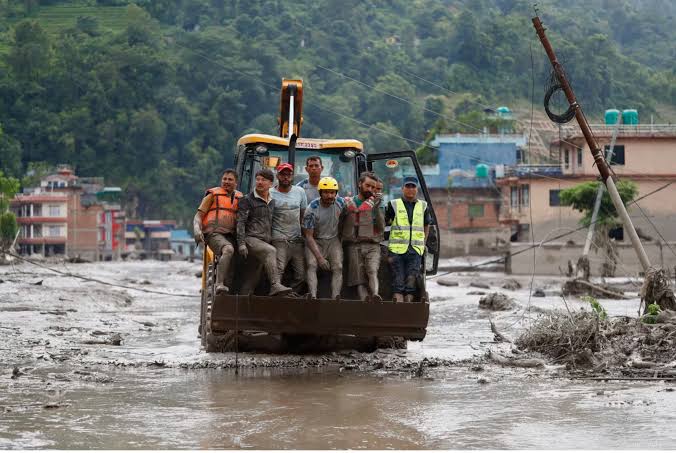
Nepal’s devastating floods have created another grim challenge for authorities: finding enough space to store the growing number of bodies recovered from disaster-hit areas.
Morgues in several districts are nearing or have exceeded capacity as bodies swept downstream by powerful floods are being recovered far from where the victims were last seen. Authorities are now turning to temporary facilities, unused buildings, dry ice and even QR codes to manage the crisis.
At least 475 people have been reported dead after catastrophic flooding struck parts of Nepal, while bodies recovered from areas including Rasuwa and Nuwakot have been transported to districts such as Chitwan, Tanahun, Gorkha and Nawalparasi.
Temporary morgues created as hospitals run out of space
Hospitals in Nuwakot, Dhading and Nawalparasi have struggled to accommodate the remains, prompting authorities to transfer bodies to neighbouring districts.
In Chitwan, an unused building in Bharatpur is being converted into a temporary body-storage facility. The site is expected to accommodate around 250 bodies, while local hospital morgues can collectively hold only around 30 to 50.
If that capacity is exceeded, authorities plan to use the electric crematorium at Devghat as an additional facility.
Bharatpur Metropolitan City is also expected to equip the facility with air-conditioning and use dry ice to slow the decomposition of bodies.
Pokhara morgues also under pressure
The situation is similarly strained in Pokhara, where bodies have arrived from several flood-hit districts.
As many as 93 bodies have reportedly been transported to Pokhara from Tanahun, Gorkha, Nawalparasi East and Dhading.
However, hospitals across Kaski district have a combined capacity of about 88 bodies. The Pokhara Academy of Health Sciences alone can accommodate 72.
Officials said the bodies are currently being kept at temperatures between 2°C and 6°C, a method that can preserve remains for roughly 10 days to two weeks.
Longer-term storage would require facilities capable of maintaining sub-zero temperatures, officials said.
QR codes and DNA samples to help identify victims
The large number of unidentified bodies has also created an urgent identification challenge.
Police are photographing remains, collecting fingerprints and DNA samples and conducting post-mortems. Authorities are also releasing photographs of bodies that can potentially be identified visually, hoping families will be able to locate missing relatives.
Each unclaimed body will receive a tag number, with details of its burial recorded. DNA samples are being sent to Kathmandu for further testing.
Authorities have also introduced a QR code system to assist families in identifying victims.
Officials said bodies cannot be kept indefinitely when relatives cannot be located. The identification process is therefore intended to preserve crucial information even if immediate identification is impossible.
Fresh flood alert forces evacuations
The humanitarian crisis has been compounded by warnings of more flooding.
Nepal Police issued a fresh flood alert for the Trishuli area on Friday, prompting authorities to evacuate residents and halt rescue and roadwork operations in vulnerable locations.
Vehicles and rescue personnel were moved to safer areas amid warnings that water levels could rise further.
The warning followed a magnitude 5.1 earthquake in Sichuan, southwest China, while Nepalese authorities also reported information about another possible dam breach on the Tibet side.
Army rescues workers from hydropower tunnel
Rescue operations continued elsewhere despite the deteriorating conditions.
The Nepali Army has been working at a hydropower project in Rasuwa, where workers were trapped inside a tunnel following the flooding. Two workers have so far been rescued.
Prime Minister Balendra Shah chaired a Cabinet meeting in Kathmandu on Friday as the government reviewed its response to the disaster.
With more bodies continuing to be recovered and fresh flood warnings disrupting rescue efforts, authorities are facing a race against time to locate survivors, identify victims and provide dignified care for the dead.