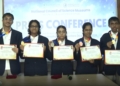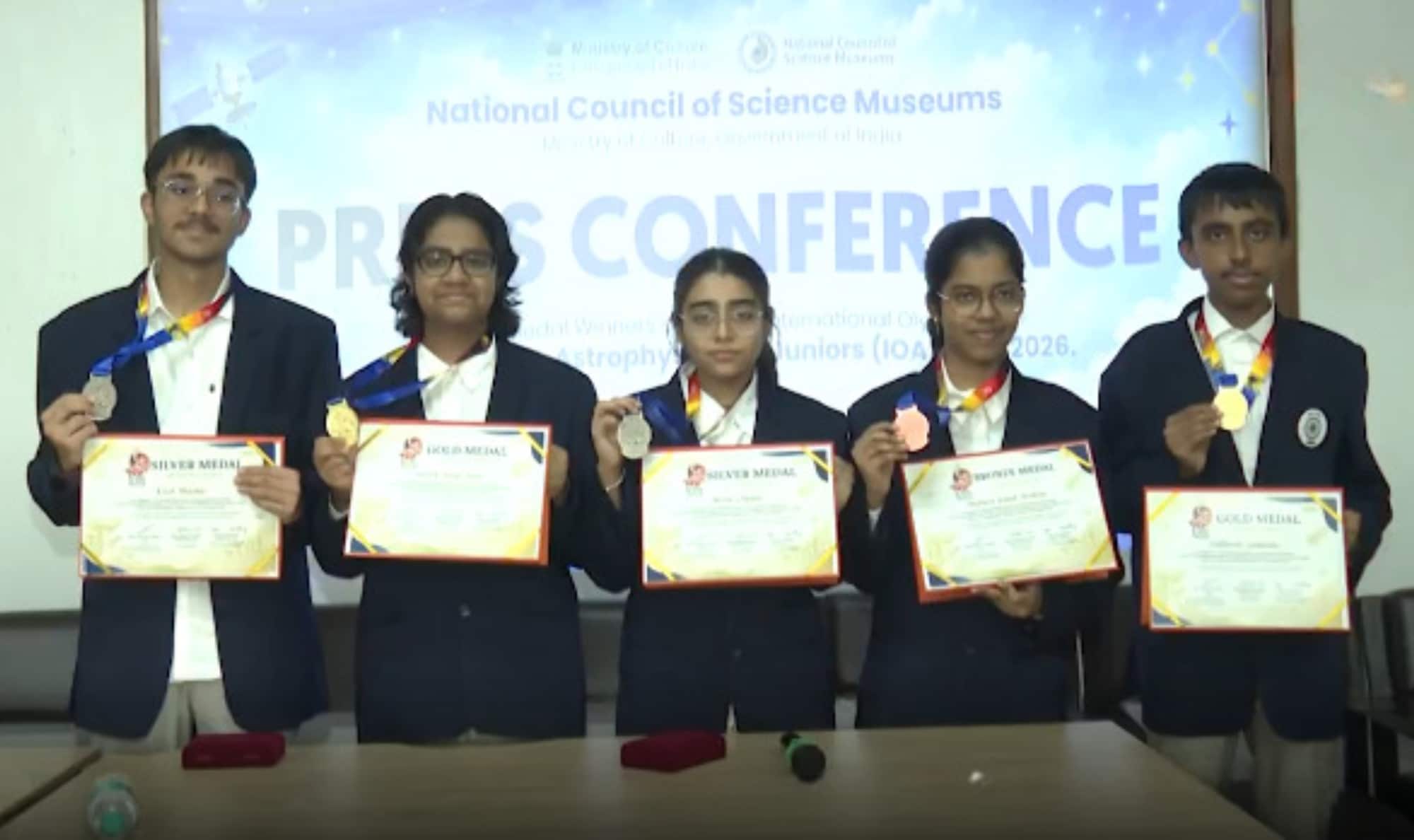
India achieved a remarkable feat at the 5th International Olympiad on Astronomy and Astrophysics for Juniors (IOAA-Jr) 2026, with its young contingent securing five medals, including two gold, two silver and one bronze, at the prestigious global competition held in Ubon Ratchathani, Thailand.
The five-member Indian team competed against 104 students from 25 countries during the event, which was held from November 1 to 8. The competition brought together some of the brightest young minds in astronomy and astrophysics, accompanied by team leaders and observers from across the world.
Leading India’s stellar performance were Siddharth Laxmisha of Aditya Vidyashram Residential School, Puducherry, and Swara Srujal Patel of School of Excellence, Gujarat, who won gold medals.
The silver medals were secured by Aarna Chaplot of Maa Bharti Senior Secondary School, Kota, and Krish Bhaskar of KS International Academy, Bagar, Rajasthan. Akshara Gulab Ambone of Lords Public School, Maharashtra, earned the bronze medal, completing India’s impressive medal tally.
Addressing a press conference, National Council of Science Museums (NCSM) Director General K S Murali congratulated the students on their outstanding achievements.
“Winning two gold, two silver and one bronze medal at this prestigious international event reflects their dedication, scientific aptitude and perseverance,” Murali said.
Gold medallist Swara Srujal Patel described the experience of representing India on an international stage as both enriching and inspiring. She credited the guidance and training provided by NCSM for helping her prepare for the competition.
Silver medallist Krish Bhaskar, who aspires to become an astrophysicist, said winning the medal filled him with pride and gave him the opportunity to interact with talented students from around the globe.
“It was a memorable experience interacting with other students from different parts of the globe. We felt like one family,” he said.
The NCSM, functioning under the Ministry of Culture, facilitated India’s participation in the Olympiad. It conducted the selection process and provided intensive training under its Junior Astronomy Olympiad programme.
According to Murali, 25 shortlisted students underwent rigorous training last month in theoretical and observational astronomy, problem-solving techniques and night-sky observations before the final team was selected.
Apart from preparing students for international competitions, NCSM operates Astronomy Education Centres across its science museums, promoting awareness of astronomy through planetariums, exhibitions, sky observation programmes and expert lectures.
India’s strong showing at IOAA-Jr 2026 highlights the growing interest and excellence of young students in astronomy and space sciences, further strengthening the country’s presence in international scientific competitions.