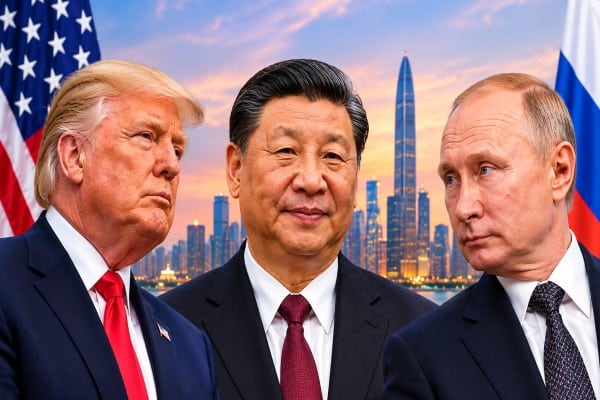
Diplomatic capitals from Brussels to New Delhi are tracking events in southern China with a mix of caution and anticipation on Thursday, November 19, 2026, as US President Donald Trump, Russian President Vladimir Putin, and Chinese President Xi Jinping convene for a historic trilateral summit on the sidelines of the APEC Summit in Shenzhen.
With an expansive agenda targeting peace negotiations over Ukraine and Iran alongside global nuclear arms control, the rare three-way gathering has prompted anxious comparisons—including from Ukrainian President Volodymyr Zelensky—to the 1945 Yalta Conference, amid fears among European and Asian allies that Washington could trade away influence over Ukraine or Taiwan.
Why Veteran Diplomats Reject the ‘Yalta 2.0’ Analogy
Despite concerns triggered by Trump’s recent criticism of Ukrainian strikes on Russian energy infrastructure, brief disruptions to Ukraine’s Starlink access, and a pause on a proposed $14 billion arms package for Taiwan, former senior US officials argue that the three leaders are meeting as wary competitors rather than wartime allies:
-
- Deep Structural Rifts Persist: Behind the handshakes, Washington continues to arm Ukraine against Russian forces, while Beijing backs Moscow with dual-use technology and joins Russia in supporting Tehran. Moreover, analysts note China remains reluctant to enter nuclear-arms limits while expanding its strategic arsenal.
- No US Retreat From Asia: Carnegie Endowment Vice President and former US Deputy Assistant Secretary of State Evan Feigenbaum dismissed “Yalta 2.0” talk, pointing out that Washington’s latest National Security Strategy explicitly asserts American primacy in Asia. Instead, experts say each leader is leveraging the summit’s global optics—Trump for diplomatic spectacle, Putin to demonstrate Russia is not isolated, and Xi to project prestige ahead of a key 2027 Chinese Communist Party leadership conclave.
“There is not a shred of evidence that the United States is prepared to cede Asia to Chinese primacy. If anything, Washington continues to both assert and presume its own primacy there… Yalta is clearly a bad analogy for whatever Trump is up to here.”
— Evan Feigenbaum, Vice President, Carnegie Endowment
What the Shenzhen Talks Mean for India
For New Delhi, both the three-way summit and Trump’s separate bilateral talks with Xi carry direct economic and strategic stakes:
-
-
- Tariff Relief & Global Grain Supply: Progress toward a Ukraine ceasefire could deter Washington from imposing fresh secondary penalties on Russian energy buyers—such as the 25% tariff penalty levied on Indian exports in August 2025—while aiding India’s diplomatic push to stabilize global food-grain shipments from the Black Sea region.
- US–China Trade Truce & the Quad: New Delhi is equally focused on whether Trump and Xi extend their bilateral trade truce into 2027 despite fresh US restrictions blocking Chinese firms from remote access to advanced AI chips. A calibrated balance of managed competition between Washington and Beijing—even alongside Trump’s subdued focus on the Quad—has historically worked to India’s strategic advantage.
-