To remove bureaucratic hurdles and eliminate overlapping categories, India’s Ministry of Home Affairs (MHA) has officially revised its national visa framework.
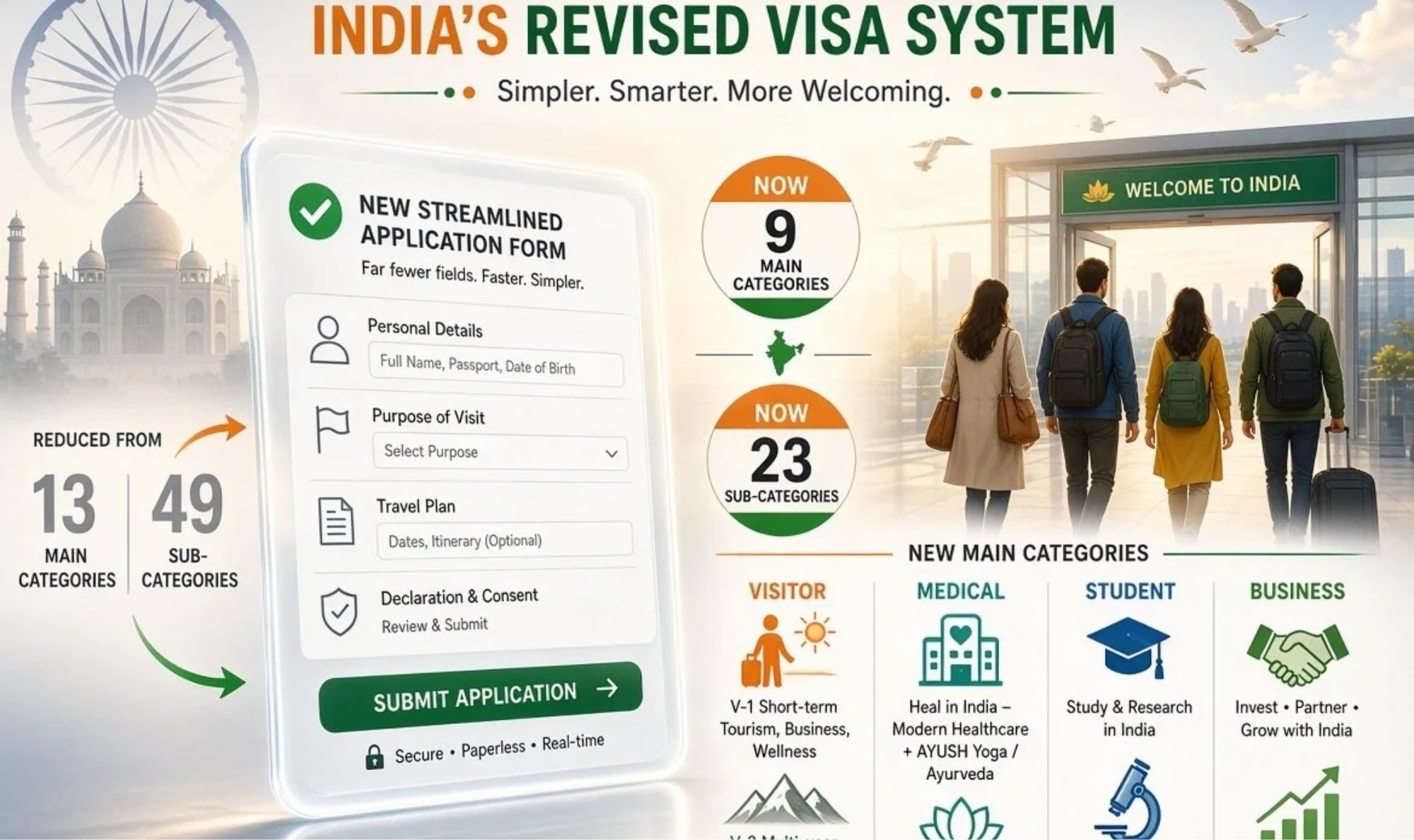
Announced publicly following a rationalisation process, the sweeping updates reduce the total number of main visa categories from 13 to 9, and sub-categories from 49 to 23.
To dramatically improve the user experience for foreign nationals, the government has also slashed the number of mandatory application form fields by 65% to 70%. The upgraded IT systems are currently under development, with full operational rollout expected by the end of 2026.
Key Changes Across Major Categories
-
The Visitor Visa (Replaces Tourist Visa): The traditional Tourist Visa has been rebranded as the Visitor Visa and split into two targeted sub-categories:
-
V-1 Visitor Visa: Tailored for short-term visits (30 days, multiple-entry), covering tourism alongside business meetings, medical consultations, wellness retreats, and short courses in Indian arts, music, or languages.
-
V-2 Visitor Visa: Designed for longer durations, offering a validity of 1, 5, or 10 years. It includes all V-1 activities plus a dedicated 6-month multiple-entry option for mountaineering expeditions.
-
-
Medical Visas (M-1 to M-4): To support the ‘Heal in India’ initiative, medical travel has been reorganised to separate conventional treatments (M-1 for patients, M-2 for attendants) from traditional AYUSH systems—Ayurveda, Yoga, Unani, Siddha, and Homoeopathy (M-3 for patients, M-4 for attendants). Most medical and electronic variants will grant 1-year multiple-entry access.
-
Student Visas (S-1 and S-2): Structured into standard schooling/degrees (S-1) and research/PhD/internship programs (S-2). Students entering through the Study in India portal can secure multi-year e-S1 visas lasting up to 5 years or for the duration of their course.
-
Business Visas (B-1 and B-2): Divided into long-term venture establishment (B-1) and short-term contract/conference/cultural activities (B-2), alongside clear provisions for technical experts and machinery installation assignments.
By trimming redundant paperwork and introducing flexible multi-year validity windows, India aims to provide a cleaner, more coherent framework that seamlessly accommodates international travellers.