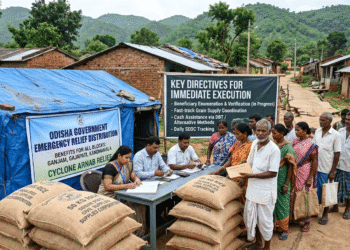
The Odisha government has firmly dismissed allegations that the recent catastrophic floods in the Ganjam district were man-made, attributing the disaster instead to unprecedented and relentless heavy rainfall.
Addressing a special press conference at Lok Seva Bhawan, Chief Secretary Anu Garg presented comprehensive data to clarify the administration’s handling of the crisis. She revealed that the river systems of Rushikulya and Bahuda experienced extreme discharge due to continuous heavy downpours spanning three days, making the situation exceptionally severe.
Record-Breaking Rainfall Surpasses Phailin
According to official figures, Patrapur block recorded a staggering 546 mm of rainfall in a single day, surpassing the extreme downpours witnessed during the devastating Phailin cyclone in 2013. Factoring in preceding and succeeding days, the region received cumulative rainfall that was 65% higher than Phailin, with multiple areas logging historic highs exceeding 300 mm. Unlike Phailin—which brought concentrated, single-day intensity—the prolonged three-day spell overwhelmed local drainage capacities.
Dam Management and River Dynamics
Addressing criticisms regarding reservoir operations, the Chief Secretary pointed out that the catchment area of the Rushikulya and Bahuda river systems spans approximately 9,800 square kilometres. Out of this, only about 10% (around 880 sq km) of runoff enters reservoirs, while the remaining 90% of water flows directly into the river systems.
Reservoir gates were opened systematically in accordance with standard operating procedures (SOPs) and incoming water levels to prevent structural failure. At Purushottampur, the river discharge touched 6,907 cumecs—roughly double the river’s normal carrying capacity. Despite this massive volume, the government’s primary objective remained dam safety and zero loss of human life, an objective successfully met through timely evacuations. Furthermore, a central team’s submitted report has corroborated that unprecedented weather was the sole catalyst behind the crisis.
Rapid Post-Flood Restoration
Relief and rehabilitation efforts across Ganjam and Gajapati are progressing at a rapid pace:
-
Power Supply: Restored to roughly 99.99% of consumers.
-
Drinking Water: Over 4,000 tube wells have been repaired, alongside 408 out of 420 damaged pipeline networks.
-
Agriculture & Irrigation: Canal restoration work is underway to ensure irrigation remains uninterrupted, while assessments for crop compensation are actively ongoing.
While opposition parties had previously blamed delayed water release and inadequate pre-disaster planning for the crisis, the administration’s data-driven response highlights that natural extremes, coupled with rigorous safety protocols, dictated the unfolding of events.