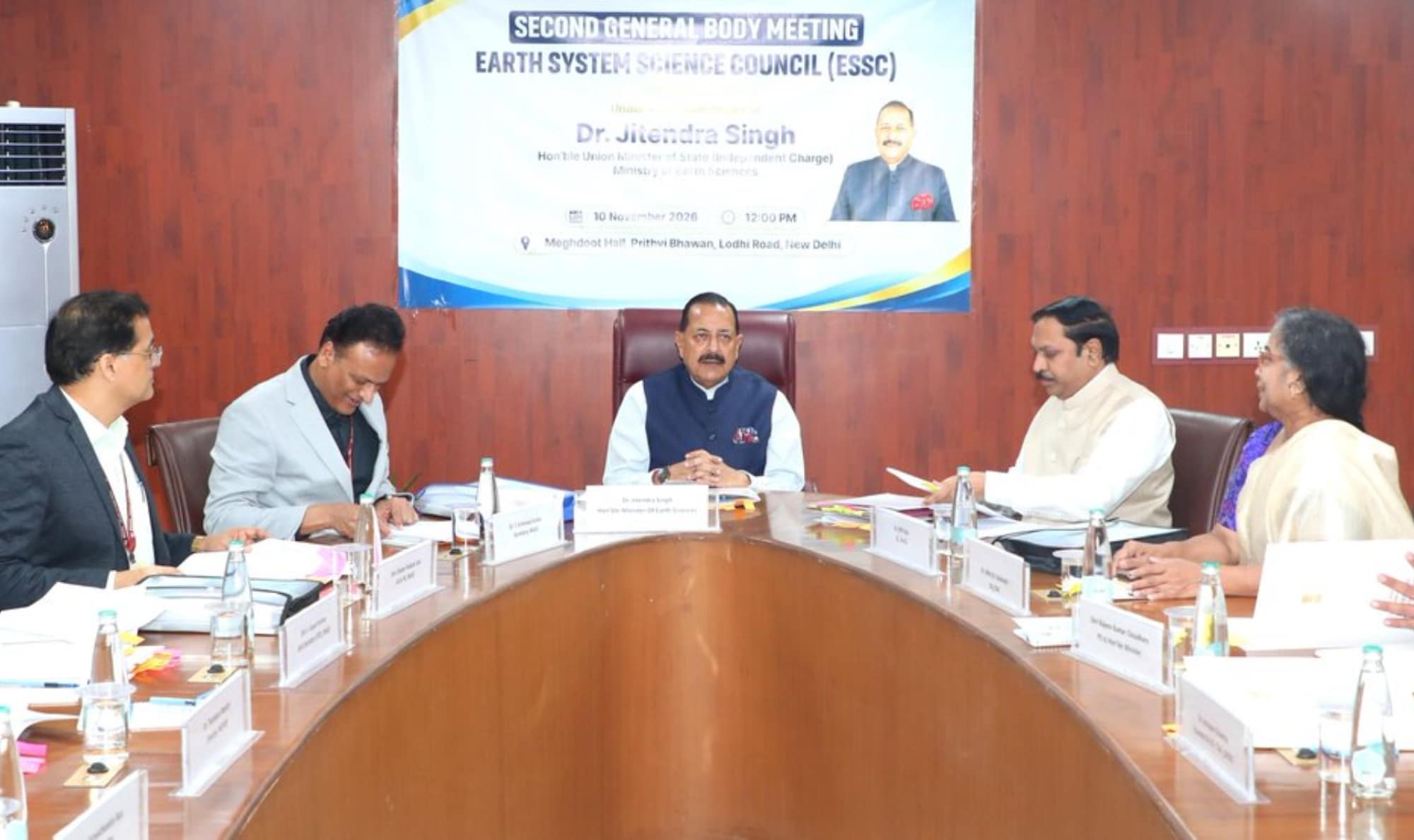
Union Minister of State (Independent Charge) for Science & Technology and Earth Sciences, Dr Jitendra Singh, chaired the Second General Body Meeting of the Earth System Sciences Council (ESSC) in New Delhi, putting a strong emphasis on citizen-centric science communication and translating complex scientific breakthroughs into accessible narratives for the public.
The high-level meeting brought together key leaders, including Secretary, Ministry of Earth Sciences, Dr. T. Srinivasa Kumar; Director General, CSIR, Dr. N. Kalaiselvi; and senior scientists from across the nation to evaluate the annual reports and audited accounts (FY 2025–26) of five premier institutions under the ESSC: the National Institute of Ocean Technology (NIOT), Indian National Centre for Ocean Information Services (INCOIS), National Centre for Earth Science Studies (NCESS), Indian Institute of Tropical Meteorology (IITM), and National Centre for Polar and Ocean Research (NCPOR).
Empowering Public Understanding through Science Communication
Addressing the gathering, Dr Jitendra Singh stressed that scientific innovations and technological milestones must be communicated in simple, engaging language so that ordinary citizens can appreciate their direct relevance and national significance. He urged institutions to integrate professional communication expertise, encourage active media coordination, and use creative multimedia formats to showcase public services, technological applications, and research outcomes effectively.
Deep Ocean Mission and Indigenous Innovations
Reviewing the progress of the Deep Ocean Mission, the Minister highlighted major milestones in India’s human deep-sea exploration programme, spearheaded by MATSYA-6000—the nation’s 6,000-metre depth-rated human submersible. He noted that Indian aquanauts successfully completed notable deep dives of 4,025 and 5,002 metres during a joint Indo-French expedition aboard the submersible Nautile, marking a watershed moment in India’s deep-sea capabilities.
Furthermore, NIOT shared updates on localised indigenous technologies, such as sustainable desalination solutions for Lakshadweep, offshore fish cage farming, advanced oceanographic instruments, deep-sea mineral prospecting, and Ocean Thermal Energy Conversion (OTEC).
Advancing Meteorology and Public Services
The review extended to atmospheric and weather systems under Mission Mausam and the PRITHVI programme, focusing on the rollout of the Bharat Forecasting System and modernised numerical weather prediction networks. IITM’s integration of Artificial Intelligence (AI) and Machine Learning (ML) into weather forecasting models is significantly elevating India’s preparedness for extreme climate events.
Concurrently, INCOIS continues to expand its localised marine advisories, multi-lingual fishing updates, and swell-surge inundation forecasts, directly empowering coastal communities, fishermen, and maritime stakeholders.
Polar Expeditions and Solid Earth Research
The council assessed major strides in polar and solid earth studies:
-
NCESS showcased vital contributions regarding landslide research, tectonic processes, and Western Ghats rainfall patterns.
-
NCPOR reported on the ongoing 45th Indian Antarctic Expedition (comprising 95 members), the 16th Arctic Expedition, and continuous glacier monitoring in the Himalayas, fortifying India’s role in global climate research and carbon cycle analysis.
Concluding the session, Dr Jitendra Singh proposed a mission-mode approach for polar and solid earth sciences to accelerate research outcomes. He praised the collaborative spirit of the institutions, describing them as an extended scientific family dedicated to strengthening India’s position as a global leader in Earth sciences.