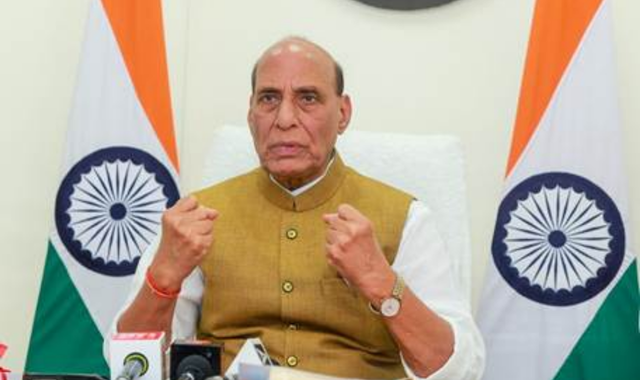
India must transition from being a mere consumer of advanced technologies to becoming a global developer, innovator, and leader in critical domains, Defence Minister Rajnath Singh declared on Saturday.
Virtually addressing a gathering of over 2,000 industry leaders, researchers, and professionals in Hyderabad, the Raksha Mantri underscored that strengthening India’s indigenous Non-Destructive Testing (NDT) ecosystem is paramount to bolstering defence preparedness and achieving true self-reliance.
Speaking at the joint inauguration of the 36th Annual Conference on Non-Destructive Evaluation & Enabling Technologies and the 15th International Symposium on Non-Destructive Testing in Aerospace—organised by the Indian Society for Non-Destructive Testing—Shri Singh delivered a clear message: in strategic applications, there can be zero compromise on the integrity of testing results.
“Aatmanirbharta is a Strategic Necessity” Framing self-reliance as a matter of national survival rather than just fiscal policy, the Defence Minister stated, “India’s pursuit of Aatmanirbharta in defence is not merely an economic objective but also a strategic necessity.” To secure critical supply chains and reduce foreign dependencies, he called for rapid domestic development in specialised sensors, evaluation equipment, and associated software.
Shifting from Defect Detection to Prevention
Using a relatable medical analogy, Shri Singh explained that just as X-rays and ultrasounds examine the human body without surgery, NDT allows engineers to inspect vital defence hardware—from missiles and naval vessels to spacecraft—without dismantling or damaging them.
However, as India’s indigenous arsenal grows more sophisticated—exemplified by milestones like the aircraft carrier INS Vikrant and advancements in radar and missile systems—testing protocols must evolve. “Hidden defects can affect operational availability, increase maintenance requirements, reduce the service life of equipment and, in critical situations, jeopardise mission success,” he warned. “We need to move beyond a culture of merely identifying defects towards actively preventing them by embedding quality at every stage of the manufacturing process.”
Integrating AI, Robotics, and Digital Twins
Highlighting the rapid technological transformation in structural health monitoring, Shri Singh urged the sector to fuse traditional inspection methods with cutting-edge digital tools. He pointed to Artificial Intelligence (AI), Machine Learning, Robotics, Digital Twins, and Predictive Analytics as game-changers capable of spotting complex anomalies invisible to conventional testing.
He encouraged professionals to build bespoke Indian solutions tailored to domestic strategic needs, noting that sustained investment in R&D and skilled manpower would eventually allow Indian testing technologies to capture international markets.
A Whole-of-Ecosystem Approach
Praising existing government catalysts like Innovations for Defence Excellence (iDEX) and the Technology Development Fund (TDF), the Raksha Mantri stressed that true innovation thrives on collaboration. He called for a “whole-of-government and whole-of-ecosystem approach,” uniting Public Sector Undertakings (PSUs), private manufacturers, start-ups, MSMEs, academia, and research laboratories under a shared mission of technological leadership.
The three-day conference in Hyderabad continues to serve as a vital hub for technical deliberation, fostering partnerships aimed at future-proofing India’s aerospace and defence manufacturing sectors.