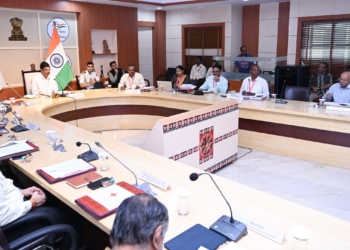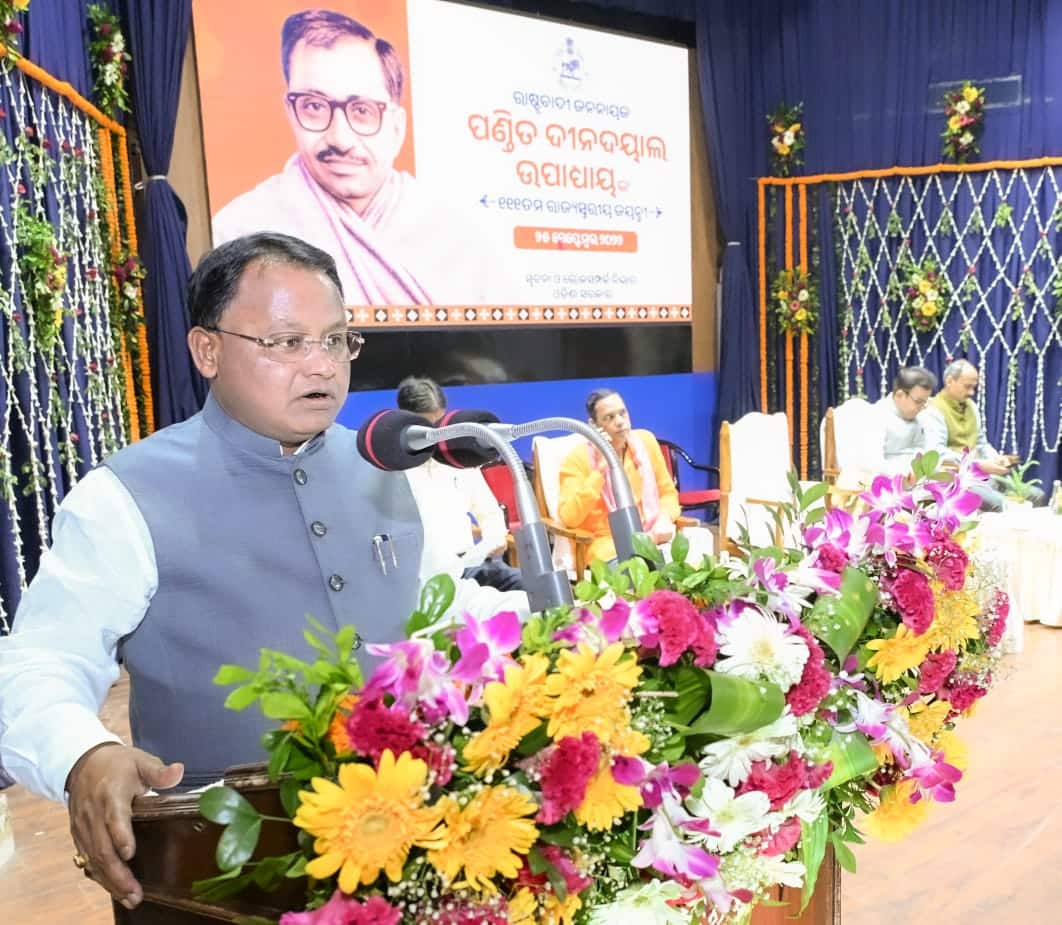
Odisha Chief Minister Mohan Charan Majhi on Friday placed Pandit Deendayal Upadhyaya’s ideas of *Ekatma Manavavad* (Integral Humanism) and Antyodaya at the centre of the state’s development agenda, saying the double-engine government is working to take growth to the person standing on the last step of society.
Addressing the 111th state-level birth anniversary programme organised by the Information and Public Relations Department at Jayadev Bhawan, Majhi described Upadhyaya as a nationalist leader, modern Indian philosopher and pioneer of cultural nationalism. The Chief Minister said those two ideas are not ceremonial talking points but the “foundation of governance” and the building blocks of a prosperous, self-reliant and self-respecting Odisha.
A homegrown alternative to imported isms
Majhi said Upadhyaya opened a new horizon of *Bharatiyata* in Indian political thought by rejecting Western capitalism, socialism and communism as ready-made templates for India. In their place, he offered a “swadeshi ism”: Integral Humanism.
The Chief Minister recalled Upadhyaya’s argument that India’s civilisational tradition is far older than the Western nation-state, and that human progress cannot be reduced to material comfort alone. Body, mind, intellect and soul must develop together, he said, and moral duty must remain the main path of society.
Majhi expressed regret that this vision was neglected for nearly five decades after Independence. The “voice of Antyodaya,” he added, rose again after Prime Minister Narendra Modi assumed office in 2014.
He linked that national shift to the ongoing month-long *Seva Sankalp Abhiyan* around the Prime Minister’s birthday — health camps, blood donation, welfare outreach, skill development and cleanliness drives meant to reach people at the margins. Schemes such as Ujjwala, Jan Dhan, Pradhan Mantri Awas Yojana, Ayushman Bharat and Make in India, he said, are turning Upadhyaya’s twin dreams of Antyodaya and self-reliance into everyday policy.
State schemes with Deendayal’s name on the door
Turning to Odisha, Majhi listed programmes he presented as the local face of that philosophy.
For families left out of the Prime Minister’s housing scheme, the state is implementing **Antyodaya Gruha Yojana**, a rural housing programme meant for the houseless and those still in kutcha homes.
For industrial workers, the government is building apartments and hostels under **Deendayal Karmachari Nivas** in industrial belts including Kalinganagar, Jharsuguda, Rourkela, Bhubaneswar, Jagatpur, Keonjhar and Damanjodi.
Food security, he said, has been widened through **Mukhyamantri Annapurna Yojana**, under which about 80 per cent of the state’s people receive an extra 5 kg of rice free of cost.
On women’s welfare, Majhi pointed to **Subhadra Yojana** and **Mukhyamantri Kanya Bibaha Yojana**, and to the planned **Mukhyamantri Kanya Sumangal Yojana**, which envisages assistance of ₹1 lakh after graduation.
Farmers, he said, are being supported through **Samriddha Krishak Yojana**, with 19 lakh cultivators receiving ₹3,100 as the value for paddy. On the investment side, he claimed proposals worth ₹22.50 lakh crore had come to the state in the last two years and three months.
The message he returned to was simple: development that stops short of the last household is incomplete.
Speakers place Antyodaya in public life
Ekamra-Bhubaneswar MLA Babu Singh said Upadhyaya was not merely a politician but a far-sighted thinker who treated public service as the first duty of government. Antyodaya, he argued, should guide every people’s representative. Bringing the crushed and excluded into the mainstream — and raising their economic and social standing — is the real work of nation-building.
Columnist, writer and researcher Dr Shiva Shakti Nath Bakshi described Integral Humanism and Antyodaya as the most reliable path for modern nation-building and social welfare.
Additional Chief Secretary (I&PR) Hemant Sharma and Director Sanjay Kumar Biswal were among the officials, guests, media persons and members of the public present.
What the day signalled
The Jayadev Bhawan programme was a commemoration, but Majhi used it as a policy speech. He tied a 20th-century philosophical vocabulary — last person, self-reliance, balanced human development — to concrete state instruments: houses for the left-out, hostels for workers, extra rice, cash for women and a higher paddy price for farmers.
Whether those schemes fully match the scale of the claim is a separate test. On Friday, the Chief Minister’s argument was that Odisha’s double-engine government now measures success the way Deendayal Upadhyaya asked the country to measure it: by how far development travels after it leaves the podium.