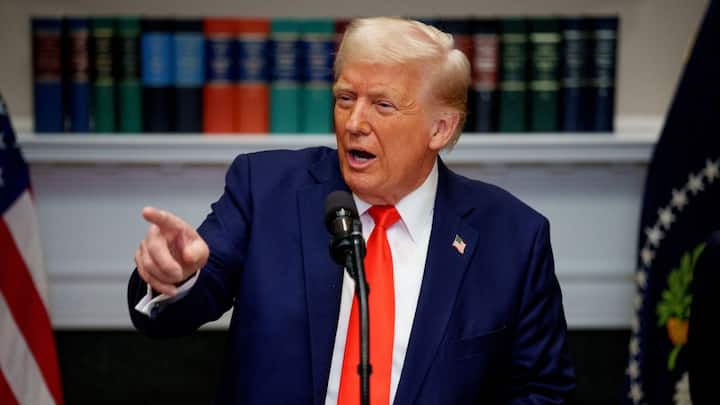
US President Donald Trump has decided, for now, against launching airstrikes on Iran-backed Houthi targets in Yemen, after briefly directing the Pentagon to prepare for military action following an appeal from Saudi Arabia.
The reported reversal comes as Washington is already engaged in a wider war with Iran. A US military campaign against the Houthis could potentially open another front and add pressure on American forces in the region.
Trump had resisted Saudi Arabia’s requests for direct US military intervention for weeks as the Houthis intensified their campaign against Saudi targets.
From no strikes to strike preparations — and back again
The issue escalated on Thursday when Saudi Crown Prince Mohammed bin Salman, who is Saudi Arabia’s de facto leader, spoke with Trump and again sought US intervention against the advancing Houthis.
According to the report, Trump had met with advisers the previous day and indicated that he did not favour launching strikes. Following the call with the Saudi crown prince, however, he changed course and instructed the Pentagon to prepare for airstrikes.
By Sunday, the administration had again decided to hold off on the strikes, at least for the time being.
The decision reportedly came even though preparations were well advanced, with commanders having approved target lists and US warplanes preparing for possible missions.
Why Saudi Arabia wants US support
Saudi Arabia has faced an intensifying campaign by the Houthis, who have launched attacks against Saudi cities and energy infrastructure and advanced along Yemen’s Red Sea coast.
Reuters reported earlier this month that Trump had previously declined a Saudi request for direct US strikes, although Washington had agreed to provide Riyadh with intelligence-sharing and targeting assistance.
The latest escalation followed Houthi missile and drone attacks targeting Saudi Arabia. The group claimed attacks on sites in Riyadh and an Aramco facility in Yanbu on September 19, while the Saudi-led coalition said it intercepted a missile aimed at Riyadh and thwarted other attacks.
Trump faces pressure over another military front
The decision presents the Trump administration with competing considerations.
Saudi Arabia is a key US partner in the region and has sought American military backing against the Houthis. At the same time, US forces are already involved in the conflict with Iran, creating concerns about the additional military resources and risks that another campaign in Yemen could require.
Some members of Trump’s administration have reportedly opposed expanding US military involvement in Yemen because of the strain created by the Iran war.
A senior US administration official, speaking about the Saudi relationship, said Washington has a defence agreement with Riyadh and would defend its allies, according to the report.
Houthis and the wider Yemen conflict
The Houthis have been fighting Yemen’s internationally recognised, Saudi-backed government since 2014. Fighting declined following a 2022 truce but has intensified again amid the broader regional conflict.
The group has recently expanded its operations along Yemen’s Red Sea coast and declared a blockade on Saudi shipping, while capturing strategically important territory near the Bab el-Mandeb Strait.
The waterway is a major shipping chokepoint connecting the Red Sea with the Gulf of Aden. Any prolonged disruption could have implications for international trade and energy supplies.
The recent fighting has already displaced more than 112,000 people inside Yemen, while nearly 3,000 people have fled by sea to Djibouti, according to the UN migration agency.
Questions over effectiveness of US strikes
The prospect of a renewed US air campaign has also raised questions over whether airstrikes alone could force the Houthis to change course.
US officials and Middle East specialists cited in the report questioned whether bombing would be sufficient to make the group negotiate or abandon its demands. The Houthis have previously endured an extended US bombing campaign without being decisively defeated.
There are also doubts over the effectiveness of supporting Yemeni forces on the ground, particularly after recent setbacks against the Houthis.
The strategic importance of the conflict extends beyond Yemen. The Houthis’ position near Bab el-Mandeb gives them potential leverage over one of the world’s key maritime routes, at a time when the Strait of Hormuz is also facing disruption because of the wider Iran conflict.
Trump’s decision remains open-ended
For now, the United States has held off on direct airstrikes against the Houthis, but the administration has not ruled out military action.
Trump’s latest reversal comes as Saudi Arabia continues to seek greater US support and as the wider Middle East conflict puts pressure on Washington to balance its alliances with the risks of expanding the war.
The situation remains fluid, with further Houthi attacks, Saudi responses or changes in US policy potentially altering Washington’s calculations.